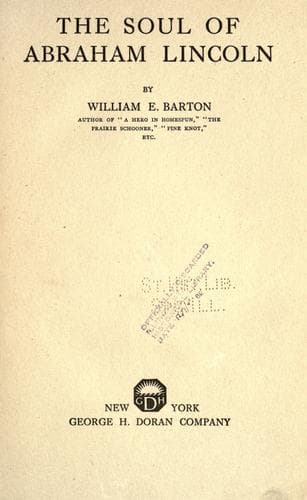
The Soul of Abraham LincolnBarton, William E. (William Eleazar)
Religion
The Soul of Abraham Lincoln
Barton, William E. (William Eleazar)
Lincoln, Abraham, 1809-1865 -- Religion; Presidents -- United States -- Biography
Similar testimony, to the extent of a page or more of finely printed
matter, Mr. Lamon attributes to Col. Jas. H. Matheny, of Springfield,
Ill., an old acquaintance of Mr. Lincoln, an able lawyer and of high
standing in the community. Mr. Matheny testifies that he never wrote a
word of what is attributed to him; that it is not a fair representation
of either his language or his opinions, and that he never would have
allowed such an article to be published as covering his estimate of Mr.
Lincoln's life and character. Here is what this gentleman has to say,
given over his own signature:--
SPRINGFIELD, Dec. 16th, 1872.
REV. J. A. REED:
DEAR SIR--The language attributed to me in Lamon's book is not from
my pen. I did not write it, and it does not express my sentiments of
Mr. Lincoln's entire life and character. It is a mere collection of
sayings gathered from private conversations that were only true of Mr.
Lincoln's earlier life. I would not have allowed such an article to
be printed over my signature as covering my opinion of Mr. Lincoln's
life and religious sentiments. While I do believe Mr. Lincoln to have
been an infidel in his former life, when his mind was as yet unformed,
and his associations principally with rough and skeptical men, yet
I believe he was a very different man in later life; and that after
associating with a different class of men, and investigating the
subject, he was a firm believer in the Christian religion.
Yours truly,
JAS. H. MATHENY.
It is unnecessary that I occupy more space with the rest of the
testimony, as there is none of it given over the signature of anybody,
save that which is given over the signature of W. H. Herndon. All aside
from this bears evidence of having been manipulated to suit the purpose
for which it is wanted, and is either contradictory, or fails to cover
the whole of Mr. Lincoln's life. Judge Davis, for instance, is made to
say: "I don't know anything about Lincoln's religion, nor do I think
anybody else knows anything about it." Of what value can the testimony
be that is prefaced with such declarations of knowing nothing about the
matter?
John G. Nicolay is made to testify, that "to his knowledge Mr. Lincoln
did not change his views after he came to Washington"; and yet he
states in immediate connection that "he does not know what his views
were, never having heard him explain them."
Jesse W. Fell either testifies, or is made to testify, to Mr. Lincoln's
skeptical notions. And yet Mr. Fell admits that it "was eight or ten
years previous to his death" that he believed him to be entertaining
the views of which he speaks, "and that he _may have changed his
sentiments_ after his removal from among us." All this would be strange
kind of testimony on which to convict Mr. Lincoln of murder in the
presence of a judge and jury. But with such evidence it is sought to
convict him of infidelity.
Public-domain text, read in full here on John Shaqi.
Reviews
Reviews
No reviews yet
Be the first to share your thoughts on this work.
Elsewhere in the archive
Join the Discussion
Join the discussion
Sign in to leave a comment or review.
Sign InorCreate an account