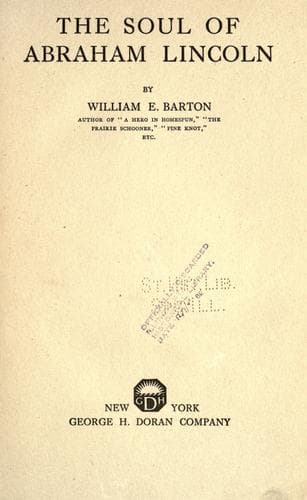
The Soul of Abraham LincolnBarton, William E. (William Eleazar)
Religion
The Soul of Abraham Lincoln
Barton, William E. (William Eleazar)
Lincoln, Abraham, 1809-1865 -- Religion; Presidents -- United States -- Biography
"The Almighty has His own purposes. 'Woe unto the world because of
offenses, for it must needs be that offenses will come; but woe unto
the man by whom the offense cometh.' If we shall suppose that American
Slavery is one of these offenses which, in the providence of God, must
needs come, but which, having continued through His appointed time, He
now wills to remove, and that He gives to both North and South this
terrible war as the woe due to those by whom the offense came, shall
we discern any departure therein from those Divine attributes which
the believers in a living God always ascribe to him? Fondly do we
hope, fervently do we pray, that the mighty scourge of war may pass
away. Yet if God will that it continue until all the wealth piled by
the bondman's two hundred and fifty years of unrequited toil shall
be sunk, and until every drop of blood drawn with the lash shall be
paid with another drawn by the sword, as was said three thousand years
ago, so must it still be said, 'The judgments of the Lord are true and
righteous altogether.'"
Thus it appears, that whether Mr. Lincoln was ever accustomed to
blaspheme the name of Jesus Christ or not, or whether he was ever
accustomed to deny His divinity or not, as his defamers allege, he
is willing, in the last eventful days of his life, standing at the
nation's Capitol, in the hearing of the swelling multitude that hangs
upon his lips, to use the sanction of Divine authority to one of the
most remarkable sentences of his official address.
Hon. Isaac N. Arnold, of Chicago, an intimate acquaintance of Mr.
Lincoln, and who is engaged in a review of his work on Mr. Lincoln's
life, writes me that "from the time he left Springfield, with the
touching request for the prayers of his friends and neighbors, to the
day of his death, his words were the words of a Christian, revering
the Bible, and obeying its precepts. A spirit of reverence and deep
religious feeling pervades nearly all the public utterances and state
papers of his later life."
The following interesting testimony from Rev. Dr. Byron Sunderland, of
the First Presbyterian Church of Washington City, gives us a little
insight into the philosophy of Mr. Lincoln's mind and religious
sentiments:
WASHINGTON CITY, Nov. 15th, 1872.
REV. JAS. A. REED:
DEAR BRO.--It was in the last days of 1862, about the time Mr.
Lincoln was seriously contemplating the issuing of the Emancipation
Proclamation, that I, in company with some friends of the President,
called upon him. After some conversation, in which he seemed disposed
to have his joke and fun, he settled down to a serious consideration
of the subject before his mind, and for one half-hour poured forth a
volume of the deepest Christian philosophy I ever heard. He began by
saying--
Public-domain text, read in full here on John Shaqi.
Reviews
Reviews
No reviews yet
Be the first to share your thoughts on this work.
Elsewhere in the archive
Join the Discussion
Join the discussion
Sign in to leave a comment or review.
Sign InorCreate an account