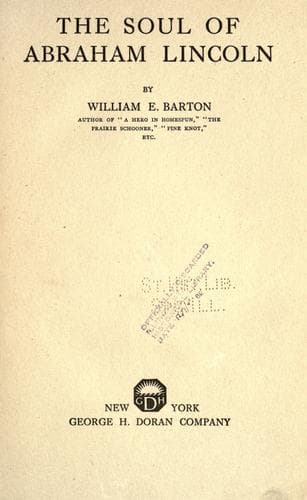
The Soul of Abraham LincolnBarton, William E. (William Eleazar)
Religion
The Soul of Abraham Lincoln
Barton, William E. (William Eleazar)
Lincoln, Abraham, 1809-1865 -- Religion; Presidents -- United States -- Biography
SIR--In regard to your inquiry, just received, of what I heard Lincoln
say about a charge of infidelity made against him when a candidate
for Congress in 1847, or '48, it was this. I was present and heard
Josiah Grady ask Lincoln a question or two regarding a charge made
against Lincoln of being an infidel, and Lincoln unqualifiedly denied
the charge of infidelity, and said, in addition, his parents were
Baptists, and brought him up in the belief of the Christian religion;
and he believed in the Christian religion as much as anyone, but
was sorry to say he had or made no pretensions to religion himself.
I can't give his exact words, but would make oath anywhere that he
positively denied the charge made against him of infidelity. That
was the first time I ever heard of the charge of infidelity against
Lincoln.
Grady did not say that he would not vote for Lincoln if he was an
infidel; but my understanding from Grady was, that he would not vote
for Lincoln if he was an infidel, and Grady did, as I suppose, vote
for him. I understood him that he should.
Respectfully,
THOMAS MOSTILLER.
MENARD COUNTY, ILL.
The next evidence I shall offer is that of Isaac Cogdal, an intimate
friend of Lincoln's from the time Lincoln came to Salem, Menard County,
to the time he left for Washington City, and I will let Cogdal speak
for himself.
STATEMENT OF ISAAC COGDAL
April 10, 1874.
B. F. IRWIN: Yours received making inquiries about what I heard
Lincoln say about his religious belief, is this, as near as I can
tell it and recollect. I think it was in 1859, I was in Lincoln's
office in Springfield, and I had a curiosity to know his opinions or
belief religiously; and I called on him for his faith in the presence
of W. H. Herndon. At least Herndon was in the office at the time.
Lincoln expressed himself in about these words: He did not nor could
not believe in the endless punishment of any one of the human race.
He understood punishment for sin to be a Bible doctrine; that the
punishment was parental in its object, aim, and design, and intended
for the good of the offender; hence it must cease when justice is
satisfied. He added that all that was lost by the transgression of
Adam was made good by the atonement: all that was lost by the fall was
made good by the sacrifice, and he added this remark, that punishment
being a "provision of the gospel system, he was not sure but the world
would be better off if a little more punishment was preached by our
ministers, and not so much pardon of sin." I then, in reply, told
Mr. Lincoln he was a sound Universalist, and would advise him to say
but little about his belief, as it was an unpopular doctrine, though
I fully agreed with him in sentiment. Lincoln replied that he never
took any part in the argument or discussion of theological questions.
Much more was said, but the above are the ideas as advanced by Lincoln
there.
Respectfully yours,
ISAAC COGDAL.
Public-domain text, read in full here on John Shaqi.
Reviews
Reviews
No reviews yet
Be the first to share your thoughts on this work.
Elsewhere in the archive
Join the Discussion
Join the discussion
Sign in to leave a comment or review.
Sign InorCreate an account