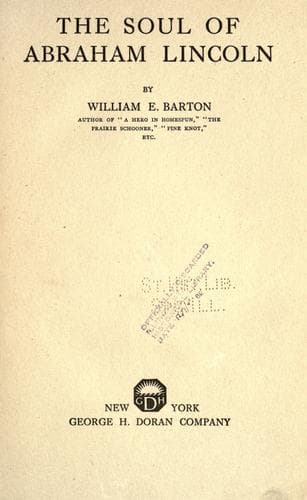
The Soul of Abraham LincolnBarton, William E. (William Eleazar)
Religion
The Soul of Abraham Lincoln
Barton, William E. (William Eleazar)
Lincoln, Abraham, 1809-1865 -- Religion; Presidents -- United States -- Biography
he was a member of that congregation, and took part and aided in all
benevolent undertakings in connection with the church. Were I allowed
to unfold to the public what is sacred, that which I know of Mr.
Lincoln's inner life during the four years he was President, his memory
would be revered by all Christians for his entire dependence during
that eventful period upon God's guidance, and not on himself. Truly no
man thought less of himself and of his nothingness without God. This is
exemplified in his public life. When assuming the Presidency, what did
he say? Speaking of the contrast of his time to Washington's:
"I feel that I cannot succeed without the same Divine Aid which
sustained him [Washington], and on the same Almighty Being I place my
reliance for support. And I hope that you, my friends, will all pray
that I may receive that Divine assistance, without which I cannot
succeed, but with which success is certain."
If an infidel, then is it possible that Abraham Lincoln could be an
honest man as the world knows he was--and make that assertion? Is it
necessary for me to say more? If so, let me remind you of his words
(1) To that zealous
LADY OF THE CHRISTIAN COMMISSION
during the war, in answer to her views of religion:
If what you have told me is really a correct view, I think I can say
with sincerity that I hope I am a Christian.
(2) To the Philadelphia Church Conference in 1864: Allow me to attest,
in response to your address, the accuracy of its historical statements;
indorse the sentiments it expresses, and thank you in the Nation's name
for the sure promise it gives. God bless the Methodist Church, God
bless all the churches, and blessed be God who giveth us, in this our
great trial, churches!
(3) To the Cabinet on the emancipation of the slaves:
"I made a solemn vow before God that if General Lee were driven from
Pennsylvania, I would crown the result by declaring freedom to the
slaves."
(4) On the same subject [slavery] remember he said: "Whatever appears
to be God's will, I will do."
ONE MORE FINAL PUBLIC ACT
and I am done. At Baltimore he was presented by the negroes of that
city with a copy of the Scriptures. In reply, Lincoln said:
"In regard to the great Book, I have only to say, it is the best gift
which God has given to man. All the good from the Saviour of the world
is communicated to us through this Book. But for that Book we could not
know right from wrong. All those things desirable to man are contained
in it."
It may appear unnecessary for me to repeat Lincoln's
PUBLIC EXPRESSIONS OF RELIGION
in conjunction with what I have issued to the world for the first time,
as to his religious life in private before he was President, but as
my object is to connect his private and public religious expressions
together, and bring them down from the time he was sixteen years old to
his death, and to show that he was, for these thirty years,
UNIFORMLY A CHRISTIAN MAN,
Public-domain text, read in full here on John Shaqi.
Reviews
Reviews
No reviews yet
Be the first to share your thoughts on this work.
Elsewhere in the archive
Join the Discussion
Join the discussion
Sign in to leave a comment or review.
Sign InorCreate an account