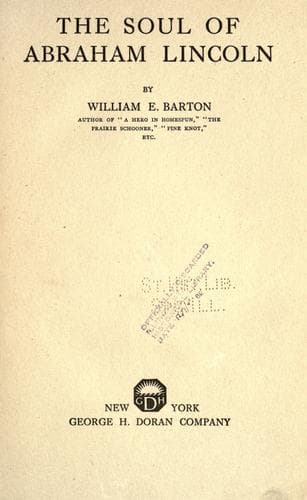
The Soul of Abraham LincolnBarton, William E. (William Eleazar)
Religion
The Soul of Abraham Lincoln
Barton, William E. (William Eleazar)
Lincoln, Abraham, 1809-1865 -- Religion; Presidents -- United States -- Biography
The books of the New Testament written by eight Jews.--Why
called New Testament? Infidels deny the genuineness
of the books.--Hold that the writers were impostors, and
the religion taught in them a fraud practiced upon mankind.
The difficulties attending the examination of the claims
of the New Testament to genuineness and credibility.--How
the subject should be approached.--The denial of the
genuineness of the books of modern dates. Toland charged
with having betrayed his suspicion that the writings were
forgeries. The suspicion of an anonymous Italian.--Its
absurdity.--Gibbon acknowledges the genuineness of the
writings.--Volney lays it down as a clear case, that no such
person as Jesus Christ ever existed. His theory adopted,
defended, and extensively circulated by Taylor. His positions
defined in his manifesto.--His unblushing falsehoods
promptly met and refuted by English Divines. Hitherto
unanswered in this country.--His first and second propositions
taken up.--How the authorship which has no name
prefixed to it is to be ascertained. The rule applied to the
New Testament 3
SECTION I.--Marks given by Michaelis by which the
spuriousness of a book may be discovered.--How books
anciently found their way to the public. The congregations
before whom the original copies of the New Testament
were read, vouchers of their genuineness.--The ancient adversaries
of Christianity admitted the genuineness of the
writings. The testimony of Trypho, the Jew. The testimony
of Celsus. The writings of Celsus against Christianity
of great value in enabling the advocate of Revelation,
of the present day, to prove that Jesus Christ is the
son of God. The testimony of Porphyry. Testimony of
Hierocles, the philosopher.--Testimony of the emperor
Julian. Testimony of Taylor himself. The quotations
from the New Testament by the most virulent enemies of
Christianity of ancient times. Demonstrate the genuineness
of the writings.--The immediate disciples of the
apostles acknowledge the genuineness of the books. The
epistles of the Apostolic fathers. Their genuineness unquestionable.
These writings prove the genuineness of the
New Testament. The epistles of Barnabas written shortly
after the destruction of Jerusalem. Table illustrating that
the New Testament writings were extant when Barnabas
wrote, or, at least, that he was conversant with some of
the writers of the book. The epistle of Clement, when and
to whom written. Table exhibiting quotations from the
New Testament in the epistle of Clement. Writings of
Hermas; when written. Table exhibiting the quotations of
Hermas from the New Testament. Ignatius, when he
flourished. Table of his quotations from the New Testament.
Polycarp, the friend of the apostle John. Table of
his quotations from the New Testament.
Public-domain text, read in full here on John Shaqi.
Reviews
Reviews
No reviews yet
Be the first to share your thoughts on this work.
Elsewhere in the archive
Join the Discussion
Join the discussion
Sign in to leave a comment or review.
Sign InorCreate an account