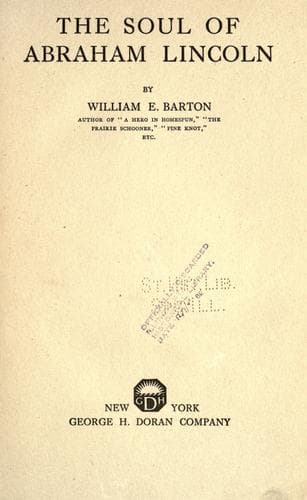
The Soul of Abraham LincolnBarton, William E. (William Eleazar)
Religion
The Soul of Abraham Lincoln
Barton, William E. (William Eleazar)
Lincoln, Abraham, 1809-1865 -- Religion; Presidents -- United States -- Biography
IN a conflict which was founded upon the quickened moral sense of
the people it was not strange that the Government received the most
earnest support from the churches. From one end of the loyal States to
the other all the religious organizations, with few exceptions, moved
by the double forces of patriotism and religion, ranged themselves
upon the side of the Government against the rebellion. A large number
of pulpits in the North had already taken their places as tribunes
for the defense of popular freedom, and it was from them that, at
the menace of war, the first cry of danger and of defiance rang out.
Those ministers who had for years been denouncing the encroachments
of slavery did not wait for any organized action on the part of their
colleagues, but proclaimed at once in a thousand varying tones that
peace was "a blessing worth fighting for." The more conservative
churches were but little in the rear of the more advanced. Those who
had counseled moderation and patience with the South on account of
the divided responsibility for slavery which rested on both halves of
the nation speedily felt the sense of release front the obligations
of brotherhood when the South had repudiated and renounced them, and
rallied to the support of the insulted flag with an earnestness not
less ardent, and more steadily trustworthy, than that of the original
antislavery clergy. As the war went on, and as every stage of it gave a
clearer presage of the coming destruction of slavery, the deliverances
of the churches became every day more and more decided in favor of
the national cause and the downfall of human bondage. To detail the
thousand ways in which the churches testified their support of the
national cause, to give even an abstract of the countless expressions
of loyalty which came from the different religious bodies of the
country, would occupy many volumes; we can only refer briefly to a
few of the more important utterances of some of the great religious
societies.
In all the church conventions which met after the President's
preliminary proclamation of the 22d of September, 1862, that act of
liberation was greeted with the heartiest expressions of approval and
support.
Public-domain text, read in full here on John Shaqi.
Reviews
Reviews
No reviews yet
Be the first to share your thoughts on this work.
Elsewhere in the archive
Join the Discussion
Join the discussion
Sign in to leave a comment or review.
Sign InorCreate an account