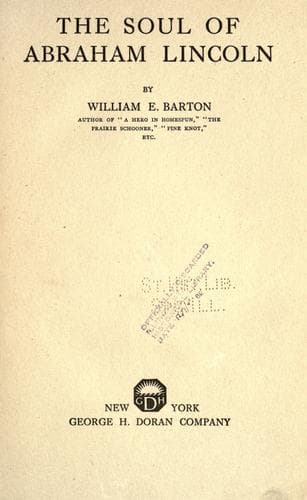
The Soul of Abraham LincolnBarton, William E. (William Eleazar)
Religion
The Soul of Abraham Lincoln
Barton, William E. (William Eleazar)
Lincoln, Abraham, 1809-1865 -- Religion; Presidents -- United States -- Biography
The date of this remarkable order leaves no possibility for the
insinuation that it sprung from any political purpose, or intention.
Mr. Lincoln had just been re-elected by an overwhelming majority;
his party was everywhere triumphant; his own personal popularity was
unbounded; there was no temptation to hypocrisy or deceit. There
is no explanation of the order except that it was the offspring of
sincere conviction. But if it may be said that this was, after all,
an exoteric utterance, springing from those relations of religion and
good government which the wisest rulers have always recognized in their
intercourse with the people, we will give one other document, of which
nothing of the sort can be said. It is a paper which Mr. Lincoln wrote
in September, 1862, while his mind was burdened with the weightiest
question of his life, the weightiest with which this century has had to
grapple. Wearied with all the considerations of law and of expediency
with which he had been struggling for two years, he retired within
himself and tried to bring some order into his thoughts by rising
above the wrangling of men and of parties, and pondering the relations
of human government to the Divine. In this frame of mind, absolutely
detached from any earthly considerations, he wrote this meditation.
It has never been published. It was not written to be seen of men. It
was penned in the awful sincerity of a perfectly honest soul trying to
bring itself into closer communion with its Maker.
"The will of God prevails. In great contests each party claims to
act in accordance with the will of God. Both _may_ be and one _must_
be wrong. God cannot be _for_ and _against_ the same thing at the
same time. In the present civil war it is quite possible that God's
purpose is something different from the purpose of either party; and
yet the human instrumentalities, working just as they do, are of the
best adaptation to effect His purpose. I am almost ready to say that
this is probably true; that God wills this contest, and wills that it
shall not end yet. By His mere great power on the minds of the now
contestants, He could have either _saved_ or _destroyed_ the Union
without a human contest. Yet the contest began. And having begun, he
could give the final victory to either side any day. Yet the contest
proceeds."
The following brief address by Mr. Lincoln appears never to have been
published. It was discovered, just as this book was going to press, by
Mr. Jesse W. Weik, who hastened to send it to me. It is the shorthand
report of a brief address delivered by Mr. Lincoln at a railroad
junction near La Fayette, Indiana, a few hours after he had left
Springfield on his way to Washington, Saturday, February 11, 1860.
W. H. B.
Public-domain text, read in full here on John Shaqi.
Reviews
Reviews
No reviews yet
Be the first to share your thoughts on this work.
Elsewhere in the archive
Join the Discussion
Join the discussion
Sign in to leave a comment or review.
Sign InorCreate an account