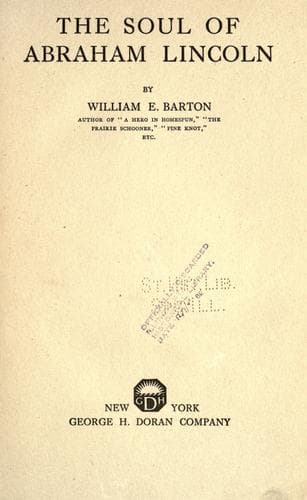
The Soul of Abraham LincolnBarton, William E. (William Eleazar)
Religion
The Soul of Abraham Lincoln
Barton, William E. (William Eleazar)
Lincoln, Abraham, 1809-1865 -- Religion; Presidents -- United States -- Biography
Lincoln arrived in New Salem on April 19, 1831, a tall, lank flatboat
hand, with his trousers rolled up "about five feet," and he left it
on a borrowed horse with all his belongings in a pair of saddlebags,
March 15, 1837. So far as worldly wealth was concerned, he was richer
when he arrived at the age of twenty-two than when he left at the
age of twenty-eight, for he was heavily in debt. It had fared better
with him financially had he spent those six years in Illinois College
at Jacksonville. He might have entered Springfield at the same time
with a college diploma and a smaller debt. A college education was
not impossible for him, and he might have had it had he cared for it
as much as did the Green brothers or the brother of Ann Rutledge, or,
among his later associates, Shelby M. Collum or Newton Bateman. It is
a fair question whether an education under such good and great men
as Julian M. Sturtevant and Edward Beecher would have been more or
less valuable than what he actually got; in any event, it was not an
impossibility if he had cared as much for it as did some other boys as
poor as he.
But New Salem was his _alma mater_, as Mrs. Atkinson has aptly termed
it, and there he got what had to stand as the equivalent of his
academic course.
To have seen him entering New Salem on a flatboat and leaving it on
a borrowed horse, one might easily have arrived at very erroneous
conclusions as to what the six years had done for him. But the years
were not lost.
He came to New Salem a strong pioneer, proud of his great height,
and he always remained almost childishly proud of it, and ready to
challenge any other tall man to back up to him and discover which was
the taller. He was capable of hard work, and disinclined to perform it.
Thomas Lincoln had taught him to work, but not to love work; and his
employers declared that he loved labor far less than his meals and pay.
If he must work, he preferred almost any kind of work rather than that
of the farm, and he had welcomed the brief experiences of the river and
had serious thoughts of being a blacksmith. He had prized his great
strength less for the labor he might perform than for the supremacy
which it gave him in physical contests; and it had made him the admired
leader of the local wrestlers and the idol of the Clary Grove gang.
Public-domain text, read in full here on John Shaqi.
Reviews
Reviews
No reviews yet
Be the first to share your thoughts on this work.
Elsewhere in the archive
Join the Discussion
Join the discussion
Sign in to leave a comment or review.
Sign InorCreate an account