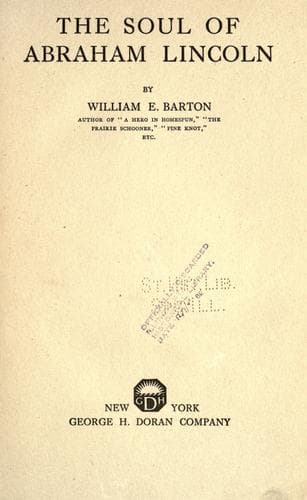
The Soul of Abraham LincolnBarton, William E. (William Eleazar)
Religion
The Soul of Abraham Lincoln
Barton, William E. (William Eleazar)
Lincoln, Abraham, 1809-1865 -- Religion; Presidents -- United States -- Biography
He had come to New Salem able to read, and to make what he called
"rabbit tracks" as clerk on election day, assisting Mentor Graham,
who rewarded him many fold in what he later taught to the young
giant. He left New Salem a competent surveyor, a member of the bar, a
representative in the Legislature, and, he might have called himself
Captain, if he had chosen to do so, or even taken advantage of the
frontier's ready system of post-bellum promotions and acquired higher
rank as an officer who had seen actual military service. He had the
good sense not to do this, and about the only commendable thing in
his one important speech in Congress in later years was his mirthful
description of his own military performance.
He had learned to think, to compose reasonably good English, to stand
on his feet and debate. He had learned to measure his intellectual
strength against that of other men, and to come out ahead at least part
of the time. He was possessed of almost inordinate ambition, and had
no false notion that in his case the office was to seek the man;[17] he
was more than ready for any office that would support him, enable him
to reduce his "national debt," and advance him toward something higher.
He was entering the profession of the law, but law was to him as yet a
means to an end, and that end was office. Politics was the vocation and
law the avocation in a large percentage of the law offices in Illinois
and other new States; and Lincoln was a politician long before he was a
lawyer.
His residence in New Salem had tested his moral character and confirmed
his personal habits. He did not drink nor swear nor use tobacco.
In a state of society such as then existed, there was almost nothing
which such a young man might not have aspired to, and Lincoln had high
self-esteem and large aspiration. From this distance we see him leaving
New Salem to "wink out" while he rode his borrowed steed far beyond
Springfield, to tether him at last where Thomas Jefferson is alleged to
have hitched his horse, to the palings of the White House.
But it was no exultant mood which possessed the soul of Lincoln as he
turned his back upon his _alma mater_ and went forth to conquer the
world. He was a briefless lawyer, and bedless as well as briefless. He
had met and mastered men, but had become painfully aware of his own
poverty, his lack of education, his utter ignorance of the usages of
even such polite society as had been in New Salem, to say nothing of
that in Springfield.
Public-domain text, read in full here on John Shaqi.
Reviews
Reviews
No reviews yet
Be the first to share your thoughts on this work.
Elsewhere in the archive
Join the Discussion
Join the discussion
Sign in to leave a comment or review.
Sign InorCreate an account