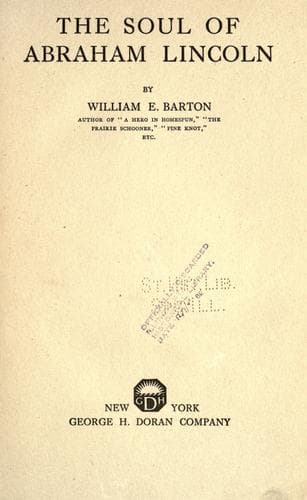
The Soul of Abraham LincolnBarton, William E. (William Eleazar)
Religion
The Soul of Abraham Lincoln
Barton, William E. (William Eleazar)
Lincoln, Abraham, 1809-1865 -- Religion; Presidents -- United States -- Biography
About this time Mr. Lincoln received word that his own father was
dying, and was prevented from making him a personal visit, which,
apparently, he was not wholly sorry for. On January 12, 1851, he wrote
to his stepbrother, John D. Johnson:
"I sincerely hope father may recover his health, but, tell him to
remember to call upon and confide in our great and good and merciful
Maker, who will not turn away from him in any extremity. He notes the
fall of a sparrow, and numbers the hairs of our head, and He will not
forget the dying man who puts his trust in Him. Say to him that if we
could meet now it is doubtful whether it would not be more painful
than pleasant, but that if it be his lot to go now, he will soon have
a joyous meeting with many loved ones gone before, and where the rest
of us, through the help of God, hope ere long to join them."
Even Herndon grew indignant when anyone attempted to explain away that
letter, or to make it seem anything less than it purported to be. He
said in his letter to Mr. Abbott, under date of February 18, 1870:
"It has been said to me that Mr. Lincoln wrote the above letter to
an old man simply to cheer him up in his last moments, and that
the writer did not believe what he said. The question is, Was Mr.
Lincoln an honest and truthful man? If he was, he wrote that letter
honestly, believing it. It has to me the sound, the ring, of an honest
utterance. I admit that Mr. Lincoln, in his moments of melancholy
and terrible gloom, was living on the border land between theism and
atheism, sometimes quite wholly dwelling in atheism. In his happier
moments he would swing back to theism, and dwell lovingly there....
So it seems to me that Mr. Lincoln believed in God and immortality as
well as heaven--a place."--LAMON, p. 495.
Another incident comes to us from this period and is related by Captain
Gilbert J. Greene. He was a young printer living in Springfield, and at
the time of this incident was eighteen years of age. Whether the story
was in any way exaggerated we may not certainly know, but it is here
given as he himself furnished it for publication and is now printed
with one or two other Lincoln stories in a small volume in limited
edition:
"'Greene,' said Lincoln to him one day on the streets of Springfield,
'I've got to ride out into the country tomorrow to draw a will for
a woman who is believed to be on her deathbed. I may want you for a
witness. If you haven't anything else to do I'd like to have you go
along.'
"The invitation was promptly accepted.
"On the way to the farmhouse the lawyer and the printer chatted
delightfully, cementing a friendship that was fast ripening into real
affection. Arriving at the house, the woman was found to be near her
end.
Public-domain text, read in full here on John Shaqi.
Reviews
Reviews
No reviews yet
Be the first to share your thoughts on this work.
Elsewhere in the archive
Join the Discussion
Join the discussion
Sign in to leave a comment or review.
Sign InorCreate an account