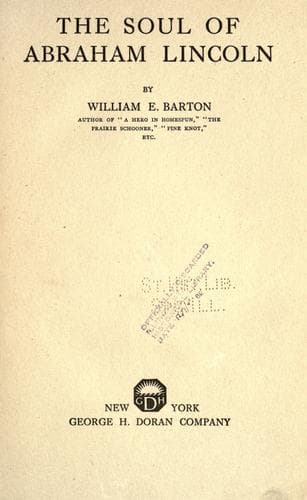
The Soul of Abraham LincolnBarton, William E. (William Eleazar)
Religion
The Soul of Abraham Lincoln
Barton, William E. (William Eleazar)
Lincoln, Abraham, 1809-1865 -- Religion; Presidents -- United States -- Biography
James Smith was a large and stalwart Scotchman. He is described as
Websterian in appearance and in the strength of logical argument. Lamon
speaks of him in contemptuous phrase which reflects little credit upon
Lamon, describing him as a man of slender ability. Whatever Dr. Smith
was, he was not a man of meager intellectual power. He had a massive
mind and one well trained. He had a voice of great carrying power and
was accustomed to speaking to large congregations both indoors and out.
He was a wide reader and a skilled controversialist. In his own young
manhood he had been a deist, and when he was converted he entered with
great ardor into various discussions with men who opposed the Christian
faith. One such discussion he had engaged in with a widely known
infidel author. The debate had continued evening after evening in a
Southern city for nearly three weeks and Dr. Smith had emerged from it
triumphant.
Dr. Smith was just the kind of man to win the admiration of Lincoln
at that time. There is some reason to believe that Dr. Smith's three
weeks' debate with C. G. Olmsted at Columbus, Mississippi, suggested to
Lincoln the idea of his debate with Stephen A. Douglas.
That Lincoln's views underwent some change at this time there is the
best reason to believe. Lincoln himself declared to his brother-in-law,
Ninian W. Edwards, that his views had been modified.
Lamon and Herndon both seek to represent Dr. Smith as an officious,
self-advertising meddler, who sought to win renown for himself by
proclaiming Mr. Lincoln's conversion through his personal influence.
The claims and conduct of Dr. Smith do not seem to merit any such
rebuke. Whatever Dr. Smith claimed, Mr. Lincoln knew about it and
was not offended by it. Subsequently he appointed Dr. Smith's son
United States Consul to Dundee, Scotland, and on the son's return to
the United States Mr. Lincoln appointed his father, who by that time
had retired from the ministry, to succeed him in that position. Even
Lamon is compelled to admit that Dr. Smith's claims were made with Mr.
Lincoln's knowledge, and says:
"Mr. Lincoln permitted himself to be misunderstood and misrepresented
by some enthusiastic ministers and exhorters with whom he came in
contact. Among these was the Rev. Mr. Smith, then pastor of the First
Presbyterian Church of Springfield, and afterward consul at Dundee, in
Scotland, under Mr. Lincoln's appointment."--LAMON, _Life of Lincoln_,
p. 498.
This statement is thoroughly discreditable, and that which follows
in Lamon's account of Mr. Lincoln's relations with Dr. Smith is a
thorough misrepresentation, as we shall later discover. Lamon was not a
deliberate liar; neither was he in this matter free from prejudice; and
he wrote with reckless disregard of some facts which he did not know
but ought to have known, and which the reader of this book shall know.
Public-domain text, read in full here on John Shaqi.
Reviews
Reviews
No reviews yet
Be the first to share your thoughts on this work.
Elsewhere in the archive
Join the Discussion
Join the discussion
Sign in to leave a comment or review.
Sign InorCreate an account