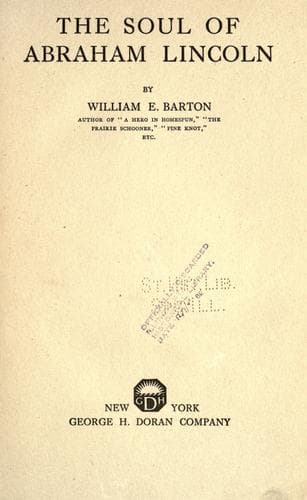
The Soul of Abraham LincolnBarton, William E. (William Eleazar)
Religion
The Soul of Abraham Lincoln
Barton, William E. (William Eleazar)
Lincoln, Abraham, 1809-1865 -- Religion; Presidents -- United States -- Biography
Some writers, and more orators, have professed to see in the character
of Lincoln a perfect balancing of all desirable qualities. Bishop
Fowler, in what was perhaps the most widely popular of all popular
orations on Lincoln, attributed his own inability to analyze the
character of Lincoln to its perfect sphericity, a consistency such that
any attempt to consider any quality by itself met the counterbalancing
consideration of all the other qualities. But the antitheses in
Lincoln's character were not those of a perfect consistency.[27] They
were of a sort which puzzled those who knew him best, and were most
easily explained by those who gave least study to the man himself and
most to their own theories of what a man like Mr. Lincoln must have
been.
Of these sharp antitheses in Lincoln's character, Col. Clark E. Carr,
who knew him well, said in an address which I heard:
"Abraham Lincoln was the drollest man I ever saw.
"He could make a cat laugh. Never was another man so vivacious; never
have I seen another who provoked so much mirth, and who entered into
rollicking fun with such glee. He was the most comical and jocose of
human beings, laughing with the same zest at his own jokes as at those
of others. I did not wonder that, while actively engaged in party
politics, his opponents who had seen him in these moods called Abraham
Lincoln a clown and an ape.
"Abraham Lincoln was the most serious man I ever saw.
"When I heard him protest against blighting our new territories with
the curse of human slavery, in his debates with Senator Douglas,
no man could have been more in earnest, none more serious. In his
analysis of legal problems, whether in the practice of his profession
or in the consideration of State papers, he became wholly absorbed
in his subject. Sometimes he lapsed into reverie and communed with
his own thoughts, noting nothing that was going on about him until
aroused, when perhaps he would enter into a discussion of the subject
that had occupied his mind, or perhaps break out into laughter and
tell a joke or story that set the table in a roar.
Public-domain text, read in full here on John Shaqi.
Reviews
Reviews
No reviews yet
Be the first to share your thoughts on this work.
Elsewhere in the archive
Join the Discussion
Join the discussion
Sign in to leave a comment or review.
Sign InorCreate an account