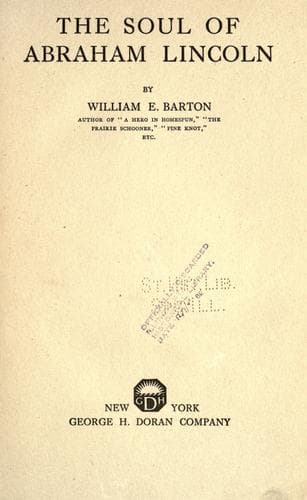
The Soul of Abraham LincolnBarton, William E. (William Eleazar)
Religion
The Soul of Abraham Lincoln
Barton, William E. (William Eleazar)
Lincoln, Abraham, 1809-1865 -- Religion; Presidents -- United States -- Biography
"According to this version, which has had considerable currency,
he carried a New Testament in his bosom, carefully hidden from
his intimate associates: he believed that Christ was God; yet his
friends understood him to deny the verity of the gospel: he based his
political doctrines on the teachings of the Bible; yet before all men,
except Mr. Bateman, he habitually acted the part of an unbeliever and
reprobate, because he was 'obliged to appear different to them.' How
obliged? What compulsion required him to deny that Christ was God
if he really believed Him to be divine? Or did he put his political
necessities above the obligations of truth, and oppose Christianity
against his convictions, that he might win the favor of its enemies?
It may be that his mere silence was sometimes misunderstood; but he
never made an express avowal of any religious opinion which he did
not entertain. He did not 'appear different' at one time from what he
was at another, and certainly he never put on infidelity as a mere
mask to conceal his Christian character from the world. There is no
dealing with Mr. Bateman, except by a flat contradiction. Perhaps
his memory was treacherous, or his imagination led him astray, or,
peradventure, he thought a fraud no harm if it gratified the strong
desire of the public for proofs of Mr. Lincoln's orthodoxy. It is
nothing to the purpose that Mr. Lincoln said once or twice that he
thought this or that portion of the Scripture was the product of
divine inspiration; for he was one of the class who hold that all
truth is inspired, and that every human being with a mind and a
conscience is a prophet. He would have agreed much more readily with
one who taught that Newton's discoveries, or Bacon's philosophy, or
one of his own speeches, were the works of men divinely inspired above
their fellows. But he never told anyone that he accepted Jesus Christ,
or performed a single one of the acts which necessarily follow upon
such a conviction. At Springfield and at Washington he was beset on
the one hand by political priests, and on the other by honest and
prayerful Christians. He despised the former, respected the latter,
and had use for both. He said with characteristic irreverence, that he
would not undertake 'to run the churches by military authority'; but
he was, nevertheless, alive to the importance of letting the churches
'run themselves in the interest of his party.' Indefinite expressions
about 'Divine Providence,' the 'justice of God,' 'the favor of the
Most High,' were easy, and not inconsistent with his religious notion.
In this, accordingly, he indulged freely; but never in all that time
did he let fall from his lips or his pen an expression which remotely
implied the slightest faith in Jesus as the Son of God and the Saviour
of men."--LAMON: _Life of Lincoln_, pp. 499-502.
Public-domain text, read in full here on John Shaqi.
Reviews
Reviews
No reviews yet
Be the first to share your thoughts on this work.
Elsewhere in the archive
Join the Discussion
Join the discussion
Sign in to leave a comment or review.
Sign InorCreate an account