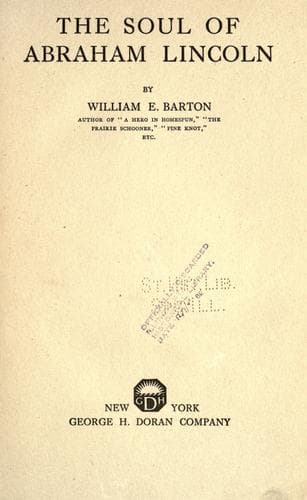
The Soul of Abraham LincolnBarton, William E. (William Eleazar)
Religion
The Soul of Abraham Lincoln
Barton, William E. (William Eleazar)
Lincoln, Abraham, 1809-1865 -- Religion; Presidents -- United States -- Biography
To accept this as containing the essential part of the interview
between Lincoln and Bateman does not involve our preferring the
statement of Herndon to that of Bateman, for we have no definite
statement of Bateman. Bateman, under close examination, told Herndon
what he remembered that Lincoln told him, and Herndon promised not to
tell it without Bateman's permission. Herndon did tell, however, that
it was very different from Holland's story, and he published this in
Lamon's book in 1872 and Bateman did not deny it. He published the
above quoted and additional note in his own book in 1889, while Bateman
was living, and Bateman did not protest. We cannot, therefore, be far
from the truth if we accept the above and stop there.
Unless the notes of Herndon's five interviews with Bateman shall be
found and published, this is probably the nearest we shall ever come
to knowing what Bateman told Herndon that Lincoln had said to him.
If those notes shall be found, they may amplify the conversation but
cannot be expected materially to modify it. This is all that it is safe
to assume of Lincoln's confession of faith to Bateman. Whoever adds to
it the glosses of the Holland biography does it at his own risk.
CHAPTER IX
THE LAMON BIOGRAPHY
WARD HILL LAMON was for many years a close friend of Lincoln.[33]
Their relations began in 1847 when Lamon settled at Danville and
continued until Lincoln's death. Both there and at Bloomington, Lamon
was Lincoln's local associate and so-called partner. When Lincoln
voted at the Presidential election of 1860, the men who accompanied
him to the polls were William H. Herndon, Ward Hill Lamon, and Col.
Elmer Ellsworth. When Lincoln was elected and his political friends
had slated Lamon for a foreign mission, Lincoln appointed him Marshal
of the District of Columbia that he might have him close at hand. He
was a member of the party which accompanied Lincoln to Washington, and
when through apparent danger of assassination the route was changed and
Lincoln slipped into Washington with a single companion, it was Lamon
whom he chose to accompany him. Lamon had charge of the arrangements of
Lincoln's trip to Gettysburg, and accompanied Lincoln and was in charge
when he visited the battlefield of Antietam. His book of personal
"Recollections," edited by his daughter and published in 1895, is full
of interest and contains much of permanent value. His _Life of Abraham
Lincoln_, published in 1872, is the most bitterly denounced of all the
biographies of Lincoln. It involved its author and publisher in heavy
financial loss, and the unsold portion of the edition is alleged to
have been bought up by friends of Lincoln and quietly destroyed. Lamon
intended to have followed this volume, whose subject-matter ended with
Lincoln's arrival in Washington in 1861, with a second volume covering
Lincoln's life as President, but neither a second volume nor a second
edition of the first was ever issued.
Public-domain text, read in full here on John Shaqi.
Reviews
Reviews
No reviews yet
Be the first to share your thoughts on this work.
Elsewhere in the archive
Join the Discussion
Join the discussion
Sign in to leave a comment or review.
Sign InorCreate an account