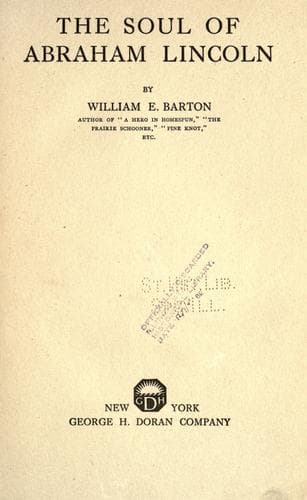
The Soul of Abraham LincolnBarton, William E. (William Eleazar)
Religion
The Soul of Abraham Lincoln
Barton, William E. (William Eleazar)
Lincoln, Abraham, 1809-1865 -- Religion; Presidents -- United States -- Biography
"It is very probable that much of Mr. Lincoln's unhappiness, the
melancholy that 'dripped from him as he walked,' was due to his want
of religious faith. When the black fit was on him, he suffered as much
mental misery as Bunyan or Cowper in the deepest anguish of their
conflicts with the Evil One. But the unfortunate conviction fastened
upon him by his early associations, that there was no truth in the
Bible, made all consolation impossible, and penitence useless. To a
man of his temperament, predisposed as it was to depression of spirit,
there could be no chance of happiness if doomed to live without hope
and without God in the world. He might force himself to be merry
with his chosen comrades; he might 'banish sadness' in mirthful
conversation, or find relief in a jest; gratified ambition might
elevate his feelings, and give him ease for a time: but solid comfort
and permanent peace could come to him only 'through a correspondence
fixed with heaven.' The fatal misfortune of his life, looking at it
only as it affected him in this world, was the influence at New Salem
and at Springfield which enlisted him on the side of unbelief. He paid
the bitter penalty in a life of misery."--LAMON, _Life of Lincoln_, p.
504.
In support of this thesis, Lamon, aided and abetted by Herndon, sought
for testimonials from those who had known Lincoln, endeavoring to
prove that he had no religious faith. Herndon himself wrote a letter
which we shall quote later because of its bearing upon a particular
point which we have yet to discuss, and gave the names of Judge Logan,
John T. Stuart, Joshua F. Speed, and James H. Matheny as those who
would confirm his declaration that Lincoln was an infidel. Herndon's
own definition of the term infidel is susceptible of such varying
definitions in his different letters and published articles that it
is not always easy to tell just what he meant by it, but in some of
these he was specific and told, from his own alleged knowledge or his
memory of the testimony of others, what Lincoln believed and denied.
Judge Logan appears not to have contributed to the discussion, but
from several of the others and from some other men whose letters
Herndon already had, Lamon made up a considerable volume of testimony
concerning the unbelief of Lincoln. Some of these we quote, reserving
others for later consideration.
Hon. John T. Stuart was alleged to have said:
Public-domain text, read in full here on John Shaqi.
Reviews
Reviews
No reviews yet
Be the first to share your thoughts on this work.
Elsewhere in the archive
Join the Discussion
Join the discussion
Sign in to leave a comment or review.
Sign InorCreate an account