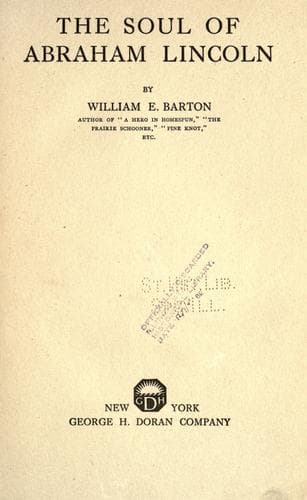
The Soul of Abraham LincolnBarton, William E. (William Eleazar)
Religion
The Soul of Abraham Lincoln
Barton, William E. (William Eleazar)
Lincoln, Abraham, 1809-1865 -- Religion; Presidents -- United States -- Biography
Herndon's regret increased that he had sold to Lamon the copies of his
papers. He was in a position where he was getting most of the blame
for what Lamon had written, and he was not wholly in sympathy with
Lamon's and especially with Black's point of view. Lamon's proposed
new edition, with the new volume that was to have covered the years
of Lincoln's Presidency, did not materialize. There was probably no
publisher who dared undertake it. At length Herndon got to work on
his own biography of Lincoln, and was fortunate in associating with
himself Mr. Jesse W. Weik, who helped him to complete it. The work was
published in 1889 by Belford, Clarke, & Company, of Chicago, and made
its appearance in three volumes. Soon after its publication the firm
failed. The books were hawked about for a song, the greater part of
the edition was unsold, and the balance of the edition is alleged to
have been bought up by Lincoln's friends and destroyed. The author of
this book paid $35.00 for his set, and could sell it at a profit.
It is a great pity that Herndon had not learned his lesson from the
fate of Lamon's book. If he had omitted some of the objectionable
matter, he would have made for himself a great name. Even as it was, he
did a great piece of work: but he gained neither money nor commendation.
In 1892, Appletons brought out a new edition in two volumes, with some
matter omitted, and some new matter by Horace White, and that edition
met with favor. But Herndon did not live to see it. He died, poor and
battle-scarred, denounced as the maligner of the man he loved.
In his younger days, Herndon drank, and it is alleged that in his
later life he used morphine. It is said that he wanted an appointment
to a Government Land Office, but that Lincoln, knowing his weakness,
did not appoint him, and that this had some share in his feeling,
which he still thought to be one of reverence for Lincoln, but which
was unconsciously tinged with resentment. To this it is answered that
Lincoln did offer Herndon an appointment which Herndon declined: but
it was not a very attractive appointment, and there is good reason
to believe that Herndon was disappointed, and that he knew Lincoln's
reason.
The name which Herndon applied to Lincoln he accepted for himself,
that of infidel. Yet it is fair to ask whether this was a just term
as applied to Herndon himself. In his lecture on Ann Rutledge, he had
occasion to defend himself in advance for views which he knew would be
heard with suspicion, and which, indeed, like almost everything he said
and did, had the unfortunate quality of increasing his unpopularity, he
said:
Public-domain text, read in full here on John Shaqi.
Reviews
Reviews
No reviews yet
Be the first to share your thoughts on this work.
Elsewhere in the archive
Join the Discussion
Join the discussion
Sign in to leave a comment or review.
Sign InorCreate an account