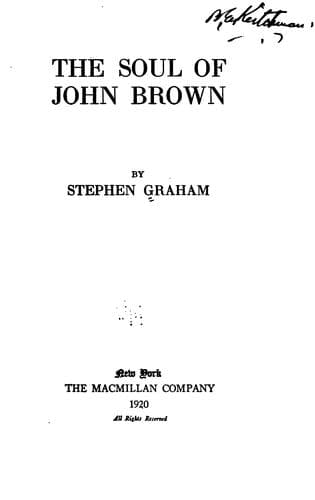
African Americans; United States -- Race relations
So out marched the four divisions (14th, 15th, 17th, and 20th) joyously
singing as they went the soldiers’ songs of the war—
One and Free
and
He who first the Flag would lower
SHOOT HIM ON THE SPOT.
and all manner of variants of John Brown to the Glory Hallelujah chorus.
The way out from Atlanta is now a road of cheap shops and Jewish
pawnbrokers, Negro beauty parlors, bag shops, gaudy cinema and
vaudeville sheds, fruit stalls and booths of quack doctors and magic
healers, vendors of the Devil’s corn cure, fortune tellers, and what
not. A Negro skyscraper climbs upward. It is decidedly a “colored
neighborhood,” and rough crowds of Negro laborers and poor Whites
frolic through the litter of the street. Painfully the electric cars
sound their alarms and budge and stop, and budge again, threading their
way through the masses, glad to get clear after half a mile of it and
then plunge into the comparative spaciousness of villadom outside the
city.
It is not as it was of yore. Where the bloody July battle of Atlanta
raged a complete peace has now settled down amid the dignified
habitations of the rich. Trees hide the view, and children play upon
the lawns of pleasant houses while the older folk rock to and fro upon
the chairs of shady verandas.
Dignified Decatur dwells on its hill by the wayside, and has reared
its pale monument to the Confederate dead. On this white obelisk the
cause of the South is justified. Within sight of it rises an impressive
courthouse, which by its size and grandeur protests the strength of the
law in a county of Georgia.
There was a gloomy sky with lowering clouds, and a warm, clammy
atmosphere as if the air had been steamed over night and was now
cooling a little. The road leaving behind Decatur and the suburbs of
Atlanta became deep red, almost scarlet in hue, and ran between broad
fields of cotton where every pod was bursting and puffing out in cotton
wool. Men with high spindle-wheeled vehicles came with cotton bales
done up in rough hempen netting. Hooded buggies rolled sedately past
with spectacled Negroes and their wives. Drummers in Ford cars tooted
and raced through the mud. Thus to Ingleside, where a turn in the road
reveals the huge hump of Stone Mountain, shadowy and mystical like
uncleft Eildons. All the soldiers as they bivouacked there or marched
past on that bright November day of ‘64 remarked the mountain, and
their gaze was turned to it in the spirit of curiosity and adventure.
I fell in with a Mr. McCaulay who was a child when Sherman marched
through. He thought the Germans in Belgium hardly equaled Sherman. Not
only did his troops burn Atlanta but almost every house in the country.
He pointed out new houses that had sprung up on the ruins of former
habitations.
Public-domain text, read in full here on John Shaqi.
Reviews
Reviews
No reviews yet
Be the first to share your thoughts on this work.
Elsewhere in the archive
Join the Discussion
Join the discussion
Sign in to leave a comment or review.
Sign InorCreate an account