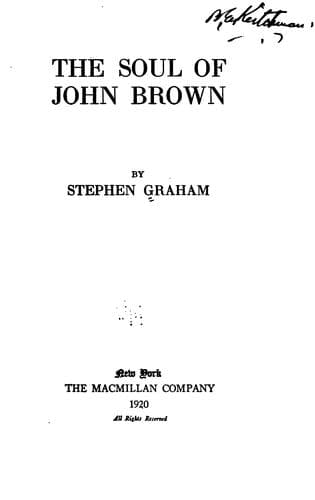
African Americans; United States -- Race relations
They told of the stillness after the army had gone, and of the sense
of ruin which was upon them with their cotton destroyed, and all their
stores for the winter pillaged, and their live stock driven off. An
old dame told me how the only live animal in her neighborhood was a
broken-down army horse left behind to die by the enemy. The folk were
starving, but a woman resuscitated the horse and went off with him to
try and bring food to the village. She walked by his side for fear he
would drop down dead—and first of all she sought a little corn for the
horse, for “Old Yank” as she called him. Many a weary mile they walked
together, only to find that “Sherman’s bummers” had been there before
her. She slept the night in a Negro hut (a thing no white woman would
dream of doing now) and the Negroes fed her and gave corn to the horse
and sent her on her way. Out of several old buggies and derelict wheels
a “contrapshun” had been rigged out and tied to the old horse, but it
was not until beyond Covington and Conyers that a place was found which
the foragers had missed, and the strange buggy was loaded for home.
I spent a night in Conyers in beautiful country, and was away early
next morning on the Covington road. The road was shadowy and sanguine.
The heavy gossamer mist which closed out the view of the hills clothed
me also with white rime. Warm, listless airs stole through the mist.
On my right, away over to the heaviness of the mist curtain, was a
sea of dark green spotted and flecked with white; on my left was the
wretched single track of the railway to Covington rebuilt on the old
levels where it was destroyed in ‘64. Wooden carts full to the rim
with picked cotton rolled clumsily along the red ruts of the road, and
jolly-looking Negroes sprawled on the top as on broad, old-fashioned
cottage feather beds. And ever and anon there overtook me the
inevitable “speed merchants,” hooting and growling and racketing from
one side to the other of the broken way. I sat down on a stone in an
old wayside cemetery, sun-bleached and yet hoary also with mist. Such
places have a strange fascination, and I knew some of those who lay
beneath the turf had lain unwitting also when the army went by. What
old-fashioned names—Sophronias and Simeons and Claramonds and Nancies!
On most of the graves was the gate of heaven and a crown, and on some
were inscribed virtues, while on one was written “He belonged to the
Baptist Church.” The oldest stones had all fallen and been washed over
with red mud. Among the old were graves of slaves, I was told, but
since the war no Black has been buried with the White.
Public-domain text, read in full here on John Shaqi.
Reviews
Reviews
No reviews yet
Be the first to share your thoughts on this work.
Elsewhere in the archive
Join the Discussion
Join the discussion
Sign in to leave a comment or review.
Sign InorCreate an account