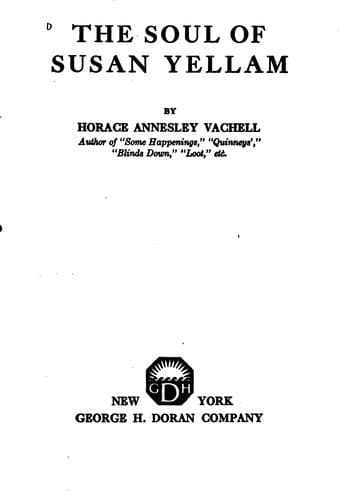
England -- Social life and customs -- 20th century -- Fiction; Villages -- England -- Fiction; World War, 1914-1918 -- Fiction
"What did 'ee up and reply to 'un, Granfer?"
The old gaffer gazed around.
"Ah-h-h! I says nothing at the time, Habakkuk Mucklow, but a very
forcible remark comes into my mind just one week too late, when I was
makin' spars in Hollywell Wood. I could ha' downscrambled 'un. 'Twas in
the month o' November that we marched so gay adown that there Regency
Street. And in November ther bain't no wheat to keep crows off. 'Twas a
shameless and very ignerunt remark."
He cackled joyously as a good Samaritan refilled his glass. William
Saint, feeling cautiously the pulse of his customers, hazarded a remark:
"The likely young fellers sat together at the end of the room, and they
kept together afterwards. I see none of them here with us to-night. What
does that mean?"
"I'll tell 'ee," replied Uncle promptly, "and in duty bound, being so
moral a man, I means to tell Squire to-morrow marning. They be afeard,
as my Garge was, till I talked to 'un. Such talk as mine, soul-stirrin',
upliftin' words, be wanted bad in Nether-Applewhite. The young fellers
has got to fight for they as brought 'un into this wicked world. I
fought in my time, as you all knows."
"Where?" asked William Saint.
Uncle replied scornfully:
"Never you mind where, Willum Saint. I can fight still, let me tell 'ee.
If you doubts that, take off your coat and come wi' me to stable-yard."
William Saint declined politely the invitation.
"Why, Uncle, I meant no offence. We all want to fight the Germans, not
to quarrel amongst ourselves. You have a glass o' ale with me."
Harmony was restored. Those present, who could hardly be expected to
fight, agreed cordially that others must do the job for them. The
youngsters needed encouragement.
"Wi' the end of a boot," concluded Uncle.
The lecture had taken place at seven. At nine the port circulated round
Sir Geoffrey's mahogany. Hamlin was present and Lionel Pomfret. How
sadly one recalls the chatter of those early days, the high hopes, the
confidence that Might would crumble away against Right, the belief in
the steam-roller--Russia. On paper, a swift result seemed assured. The
Squire had thrown off London vapours. His own words had intoxicated him.
He admitted that recruiting might hang fire in villages like Ocknell,
but not amongst _his_ people. Lionel backed him up. Lady Pomfret and
Joyce said nothing. The Parson hoped that it would be so. When Sir
Geoffrey had said everything to be said, twice over, he turned as usual
to his wife for an approving nod strangely withheld.
"Well, my dear Mary, you agree with me?"
"About the necessity of getting men--yes. But I am not so sanguine as
you, Geoffrey, about the patriotism in our village."
"Bless my soul!"
"I think Mr. Hamlin shares my apprehensions."
"I do," admitted the Parson gravely.
Lady Pomfret continued gently:
"I was talking, this afternoon, with Susan Yellam. She looks ahead. She
faces facts, as we do. But she knows the village better than we do."
"My dear----!"
Public-domain text, read in full here on John Shaqi.
Reviews
Reviews
No reviews yet
Be the first to share your thoughts on this work.
Elsewhere in the archive
Join the Discussion
Join the discussion
Sign in to leave a comment or review.
Sign InorCreate an account