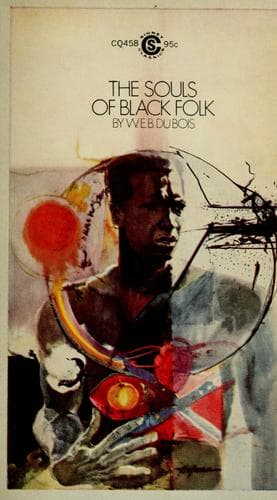
The Souls of Black FolkDu Bois, W. E. B. (William Edward Burghardt)
History
The Souls of Black Folk
Du Bois, W. E. B. (William Edward Burghardt)
African Americans
A degree above these we may place those laborers who receive money
wages for their work. Some receive a house with perhaps a garden-spot;
then supplies of food and clothing are advanced, and certain fixed
wages are given at the end of the year, varying from thirty to sixty
dollars, out of which the supplies must be paid for, with interest.
About eighteen per cent of the population belong to this class of
semi-metayers, while twenty-two per cent are laborers paid by the month
or year, and are either “furnished” by their own savings or perhaps
more usually by some merchant who takes his chances of payment. Such
laborers receive from thirty-five to fifty cents a day during the
working season. They are usually young unmarried persons, some being
women; and when they marry they sink to the class of metayers, or, more
seldom, become renters.
The renters for fixed money rentals are the first of the emerging
classes, and form five per cent of the families. The sole advantage of
this small class is their freedom to choose their crops, and the
increased responsibility which comes through having money transactions.
While some of the renters differ little in condition from the metayers,
yet on the whole they are more intelligent and responsible persons, and
are the ones who eventually become land-owners. Their better character
and greater shrewdness enable them to gain, perhaps to demand, better
terms in rents; rented farms, varying from forty to a hundred acres,
bear an average rental of about fifty-four dollars a year. The men who
conduct such farms do not long remain renters; either they sink to
metayers, or with a successful series of harvests rise to be
land-owners.
In 1870 the tax-books of Dougherty report no Negroes as landholders. If
there were any such at that time,—and there may have been a few,—their
land was probably held in the name of some white patron,—a method not
uncommon during slavery. In 1875 ownership of land had begun with seven
hundred and fifty acres; ten years later this had increased to over
sixty-five hundred acres, to nine thousand acres in 1890 and ten
thousand in 1900. The total assessed property has in this same period
risen from eighty thousand dollars in 1875 to two hundred and forty
thousand dollars in 1900.
Public-domain text, read in full here on John Shaqi.
Reviews
Reviews
No reviews yet
Be the first to share your thoughts on this work.
Elsewhere in the archive
Join the Discussion
Join the discussion
Sign in to leave a comment or review.
Sign InorCreate an account