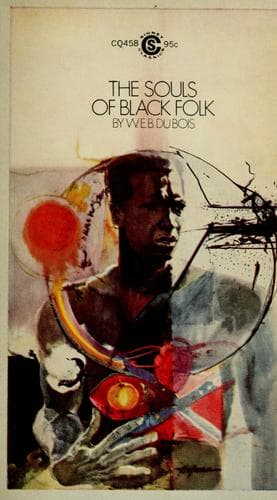
The Souls of Black FolkDu Bois, W. E. B. (William Edward Burghardt)
History
The Souls of Black Folk
Du Bois, W. E. B. (William Edward Burghardt)
African Americans
In the civilized life of to-day the contact of men and their relations
to each other fall in a few main lines of action and communication:
there is, first, the physical proximity of home and dwelling-places,
the way in which neighborhoods group themselves, and the contiguity of
neighborhoods. Secondly, and in our age chiefest, there are the
economic relations,—the methods by which individuals cooperate for
earning a living, for the mutual satisfaction of wants, for the
production of wealth. Next, there are the political relations, the
cooperation in social control, in group government, in laying and
paying the burden of taxation. In the fourth place there are the less
tangible but highly important forms of intellectual contact and
commerce, the interchange of ideas through conversation and conference,
through periodicals and libraries; and, above all, the gradual
formation for each community of that curious _tertium quid_ which we
call public opinion. Closely allied with this come the various forms of
social contact in everyday life, in travel, in theatres, in house
gatherings, in marrying and giving in marriage. Finally, there are the
varying forms of religious enterprise, of moral teaching and benevolent
endeavor. These are the principal ways in which men living in the same
communities are brought into contact with each other. It is my present
task, therefore, to indicate, from my point of view, how the black race
in the South meet and mingle with the whites in these matters of
everyday life.
First, as to physical dwelling. It is usually possible to draw in
nearly every Southern community a physical color-line on the map, on
the one side of which whites dwell and on the other Negroes. The
winding and intricacy of the geographical color-line varies, of course,
in different communities. I know some towns where a straight line drawn
through the middle of the main street separates nine-tenths of the
whites from nine-tenths of the blacks. In other towns the older
settlement of whites has been encircled by a broad band of blacks; in
still other cases little settlements or nuclei of blacks have sprung up
amid surrounding whites. Usually in cities each street has its
distinctive color, and only now and then do the colors meet in close
proximity. Even in the country something of this segregation is
manifest in the smaller areas, and of course in the larger phenomena of
the Black Belt.
Public-domain text, read in full here on John Shaqi.
Reviews
Reviews
No reviews yet
Be the first to share your thoughts on this work.
Elsewhere in the archive
Join the Discussion
Join the discussion
Sign in to leave a comment or review.
Sign InorCreate an account