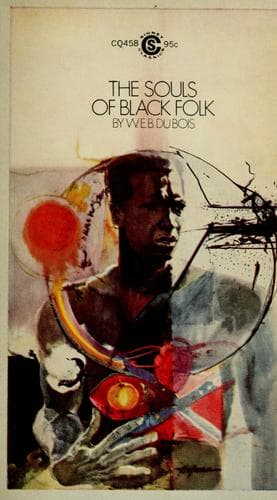
The Souls of Black FolkDu Bois, W. E. B. (William Edward Burghardt)
History
The Souls of Black Folk
Du Bois, W. E. B. (William Edward Burghardt)
African Americans
education in submission, carelessness, and stealing. After
Emancipation, it was the plain duty of some one to assume this group
leadership and training of the Negro laborer. I will not stop here to
inquire whose duty it was—whether that of the white ex-master who had
profited by unpaid toil, or the Northern philanthropist whose
persistence brought on the crisis, or the National Government whose
edict freed the bondmen; I will not stop to ask whose duty it was, but
I insist it was the duty of some one to see that these workingmen were
not left alone and unguided, without capital, without land, without
skill, without economic organization, without even the bald protection
of law, order, and decency,—left in a great land, not to settle down to
slow and careful internal development, but destined to be thrown almost
immediately into relentless and sharp competition with the best of
modern workingmen under an economic system where every participant is
fighting for himself, and too often utterly regardless of the rights or
welfare of his neighbor.
For we must never forget that the economic system of the South to-day
which has succeeded the old regime is not the same system as that of
the old industrial North, of England, or of France, with their
trade-unions, their restrictive laws, their written and unwritten
commercial customs, and their long experience. It is, rather, a copy of
that England of the early nineteenth century, before the factory
acts,—the England that wrung pity from thinkers and fired the wrath of
Carlyle. The rod of empire that passed from the hands of Southern
gentlemen in 1865, partly by force, partly by their own petulance, has
never returned to them. Rather it has passed to those men who have come
to take charge of the industrial exploitation of the New South,—the
sons of poor whites fired with a new thirst for wealth and power,
thrifty and avaricious Yankees, and unscrupulous immigrants. Into the
hands of these men the Southern laborers, white and black, have fallen;
and this to their sorrow. For the laborers as such, there is in these
new captains of industry neither love nor hate, neither sympathy nor
romance; it is a cold question of dollars and dividends. Under such a
system all labor is bound to suffer. Even the white laborers are not
yet intelligent, thrifty, and well trained enough to maintain
themselves against the powerful inroads of organized capital. The
results among them, even, are long hours of toil, low wages, child
labor, and lack of protection against usury and cheating. But among the
black laborers all this is aggravated, first, by a race prejudice which
varies from a doubt and distrust among the best element of whites to a
frenzied hatred among the worst; and, secondly, it is aggravated, as I
have said before, by the wretched economic heritage of the freedmen
from slavery. With this training it is difficult for the freedman to
learn to grasp the opportunities already opened to him, and the new
Public-domain text, read in full here on John Shaqi.
Reviews
Reviews
No reviews yet
Be the first to share your thoughts on this work.
Elsewhere in the archive
Join the Discussion
Join the discussion
Sign in to leave a comment or review.
Sign InorCreate an account