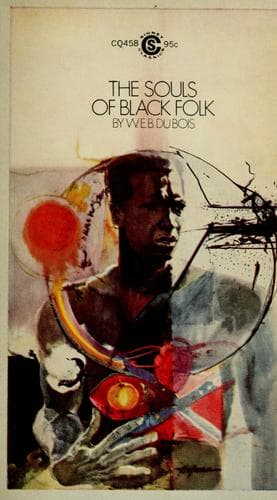
The Souls of Black FolkDu Bois, W. E. B. (William Edward Burghardt)
History
The Souls of Black Folk
Du Bois, W. E. B. (William Edward Burghardt)
African Americans
The Negro church of to-day is the social centre of Negro life in the
United States, and the most characteristic expression of African
character. Take a typical church in a small Virginia town: it is the
“First Baptist”—a roomy brick edifice seating five hundred or more
persons, tastefully finished in Georgia pine, with a carpet, a small
organ, and stained-glass windows. Underneath is a large assembly room
with benches. This building is the central club-house of a community of
a thousand or more Negroes. Various organizations meet here,—the church
proper, the Sunday-school, two or three insurance societies, women’s
societies, secret societies, and mass meetings of various kinds.
Entertainments, suppers, and lectures are held beside the five or six
regular weekly religious services. Considerable sums of money are
collected and expended here, employment is found for the idle,
strangers are introduced, news is disseminated and charity distributed.
At the same time this social, intellectual, and economic centre is a
religious centre of great power. Depravity, Sin, Redemption, Heaven,
Hell, and Damnation are preached twice a Sunday after the crops are
laid by; and few indeed of the community have the hardihood to
withstand conversion. Back of this more formal religion, the Church
often stands as a real conserver of morals, a strengthener of family
life, and the final authority on what is Good and Right.
Thus one can see in the Negro church to-day, reproduced in microcosm,
all the great world from which the Negro is cut off by color-prejudice
and social condition. In the great city churches the same tendency is
noticeable and in many respects emphasized. A great church like the
Bethel of Philadelphia has over eleven hundred members, an edifice
seating fifteen hundred persons and valued at one hundred thousand
dollars, an annual budget of five thousand dollars, and a government
consisting of a pastor with several assisting local preachers, an
executive and legislative board, financial boards and tax collectors;
general church meetings for making laws; sub-divided groups led by
class leaders, a company of militia, and twenty-four auxiliary
societies. The activity of a church like this is immense and
far-reaching, and the bishops who preside over these organizations
throughout the land are among the most powerful Negro rulers in the
world.
Public-domain text, read in full here on John Shaqi.
Reviews
Reviews
No reviews yet
Be the first to share your thoughts on this work.
Elsewhere in the archive
Join the Discussion
Join the discussion
Sign in to leave a comment or review.
Sign InorCreate an account