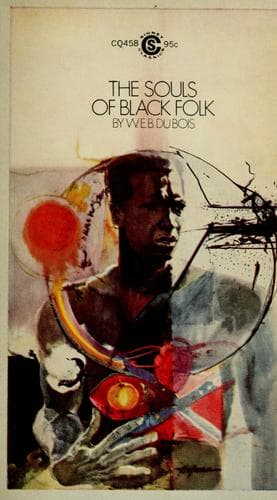
The Souls of Black FolkDu Bois, W. E. B. (William Edward Burghardt)
History
The Souls of Black Folk
Du Bois, W. E. B. (William Edward Burghardt)
African Americans
The meeting of welcome at the Baptist Church was a failure. Rain
spoiled the barbecue, and thunder turned the milk in the ice-cream.
When the speaking came at night, the house was crowded to overflowing.
The three preachers had especially prepared themselves, but somehow
John’s manner seemed to throw a blanket over everything,—he seemed so
cold and preoccupied, and had so strange an air of restraint that the
Methodist brother could not warm up to his theme and elicited not a
single “Amen”; the Presbyterian prayer was but feebly responded to, and
even the Baptist preacher, though he wakened faint enthusiasm, got so
mixed up in his favorite sentence that he had to close it by stopping
fully fifteen minutes sooner than he meant. The people moved uneasily
in their seats as John rose to reply. He spoke slowly and methodically.
The age, he said, demanded new ideas; we were far different from those
men of the seventeenth and eighteenth centuries,—with broader ideas of
human brotherhood and destiny. Then he spoke of the rise of charity and
popular education, and particularly of the spread of wealth and work.
The question was, then, he added reflectively, looking at the low
discolored ceiling, what part the Negroes of this land would take in
the striving of the new century. He sketched in vague outline the new
Industrial School that might rise among these pines, he spoke in detail
of the charitable and philanthropic work that might be organized, of
money that might be saved for banks and business. Finally he urged
unity, and deprecated especially religious and denominational
bickering. “To-day,” he said, with a smile, “the world cares little
whether a man be Baptist or Methodist, or indeed a churchman at all, so
long as he is good and true. What difference does it make whether a man
be baptized in river or washbowl, or not at all? Let’s leave all that
littleness, and look higher.” Then, thinking of nothing else, he slowly
sat down. A painful hush seized that crowded mass. Little had they
understood of what he said, for he spoke an unknown tongue, save the
last word about baptism; that they knew, and they sat very still while
the clock ticked. Then at last a low suppressed snarl came from the
Amen corner, and an old bent man arose, walked over the seats, and
climbed straight up into the pulpit. He was wrinkled and black, with
scant gray and tufted hair; his voice and hands shook as with palsy;
but on his face lay the intense rapt look of the religious fanatic. He
seized the Bible with his rough, huge hands; twice he raised it
inarticulate, and then fairly burst into words, with rude and awful
eloquence. He quivered, swayed, and bent; then rose aloft in perfect
majesty, till the people moaned and wept, wailed and shouted, and a
wild shrieking arose from the corners where all the pent-up feeling of
the hour gathered itself and rushed into the air. John never knew
clearly what the old man said; he only felt himself held up to scorn
Public-domain text, read in full here on John Shaqi.
Reviews
Reviews
No reviews yet
Be the first to share your thoughts on this work.
Elsewhere in the archive
Join the Discussion
Join the discussion
Sign in to leave a comment or review.
Sign InorCreate an account