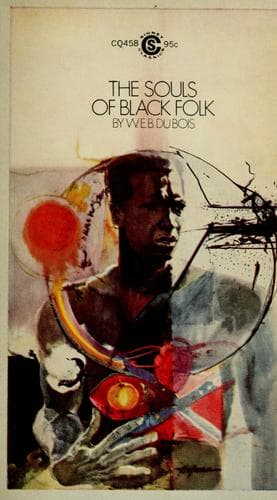
The Souls of Black FolkDu Bois, W. E. B. (William Edward Burghardt)
History
The Souls of Black Folk
Du Bois, W. E. B. (William Edward Burghardt)
African Americans
The Judge sat in the dining-room amid his morning’s mail, and he did
not ask John to sit down. He plunged squarely into the business.
“You’ve come for the school, I suppose. Well John, I want to speak to
you plainly. You know I’m a friend to your people. I’ve helped you and
your family, and would have done more if you hadn’t got the notion of
going off. Now I like the colored people, and sympathize with all their
reasonable aspirations; but you and I both know, John, that in this
country the Negro must remain subordinate, and can never expect to be
the equal of white men. In their place, your people can be honest and
respectful; and God knows, I’ll do what I can to help them. But when
they want to reverse nature, and rule white men, and marry white women,
and sit in my parlor, then, by God! we’ll hold them under if we have to
lynch every Nigger in the land. Now, John, the question is, are you,
with your education and Northern notions, going to accept the situation
and teach the darkies to be faithful servants and laborers as your
fathers were,—I knew your father, John, he belonged to my brother, and
he was a good Nigger. Well—well, are you going to be like him, or are
you going to try to put fool ideas of rising and equality into these
folks’ heads, and make them discontented and unhappy?”
“I am going to accept the situation, Judge Henderson,” answered John,
with a brevity that did not escape the keen old man. He hesitated a
moment, and then said shortly, “Very well,—we’ll try you awhile.
Good-morning.”
It was a full month after the opening of the Negro school that the
other John came home, tall, gay, and headstrong. The mother wept, the
sisters sang. The whole white town was glad. A proud man was the Judge,
and it was a goodly sight to see the two swinging down Main Street
together. And yet all did not go smoothly between them, for the younger
man could not and did not veil his contempt for the little town, and
plainly had his heart set on New York. Now the one cherished ambition
of the Judge was to see his son mayor of Altamaha, representative to
the legislature, and—who could say?—governor of Georgia. So the
argument often waxed hot between them. “Good heavens, father,” the
younger man would say after dinner, as he lighted a cigar and stood by
the fireplace, “you surely don’t expect a young fellow like me to
settle down permanently in this—this God-forgotten town with nothing
but mud and Negroes?” “_I_ did,” the Judge would answer laconically;
and on this particular day it seemed from the gathering scowl that he
was about to add something more emphatic, but neighbors had already
begun to drop in to admire his son, and the conversation drifted.
“Heah that John is livenin’ things up at the darky school,” volunteered
the postmaster, after a pause.
“What now?” asked the Judge, sharply.
Public-domain text, read in full here on John Shaqi.
Reviews
Reviews
No reviews yet
Be the first to share your thoughts on this work.
Elsewhere in the archive
Join the Discussion
Join the discussion
Sign in to leave a comment or review.
Sign InorCreate an account