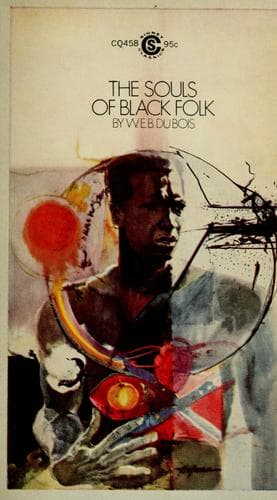
The Souls of Black FolkDu Bois, W. E. B. (William Edward Burghardt)
History
The Souls of Black Folk
Du Bois, W. E. B. (William Edward Burghardt)
African Americans
Up at the great pillared house the tall young son wandered aimlessly
about after his father’s abrupt departure. In the house there was
little to interest him; the books were old and stale, the local
newspaper flat, and the women had retired with headaches and sewing. He
tried a nap, but it was too warm. So he sauntered out into the fields,
complaining disconsolately, “Good Lord! how long will this imprisonment
last!” He was not a bad fellow,—just a little spoiled and
self-indulgent, and as headstrong as his proud father. He seemed a
young man pleasant to look upon, as he sat on the great black stump at
the edge of the pines idly swinging his legs and smoking. “Why, there
isn’t even a girl worth getting up a respectable flirtation with,” he
growled. Just then his eye caught a tall, willowy figure hurrying
toward him on the narrow path. He looked with interest at first, and
then burst into a laugh as he said, “Well, I declare, if it isn’t
Jennie, the little brown kitchen-maid! Why, I never noticed before what
a trim little body she is. Hello, Jennie! Why, you haven’t kissed me
since I came home,” he said gaily. The young girl stared at him in
surprise and confusion,—faltered something inarticulate, and attempted
to pass. But a wilful mood had seized the young idler, and he caught at
her arm. Frightened, she slipped by; and half mischievously he turned
and ran after her through the tall pines.
Yonder, toward the sea, at the end of the path, came John slowly, with
his head down. He had turned wearily homeward from the schoolhouse;
then, thinking to shield his mother from the blow, started to meet his
sister as she came from work and break the news of his dismissal to
her. “I’ll go away,” he said slowly; “I’ll go away and find work, and
send for them. I cannot live here longer.” And then the fierce, buried
anger surged up into his throat. He waved his arms and hurried wildly
up the path.
The great brown sea lay silent. The air scarce breathed. The dying day
bathed the twisted oaks and mighty pines in black and gold. There came
from the wind no warning, not a whisper from the cloudless sky. There
was only a black man hurrying on with an ache in his heart, seeing
neither sun nor sea, but starting as from a dream at the frightened cry
that woke the pines, to see his dark sister struggling in the arms of a
tall and fair-haired man.
He said not a word, but, seizing a fallen limb, struck him with all the
pent-up hatred of his great black arm, and the body lay white and still
beneath the pines, all bathed in sunshine and in blood. John looked at
it dreamily, then walked back to the house briskly, and said in a soft
voice, “Mammy, I’m going away—I’m going to be free.”
She gazed at him dimly and faltered, “No’th, honey, is yo’ gwine No’th
agin?”
He looked out where the North Star glistened pale above the waters, and
said, “Yes, mammy, I’m going—North.”
Public-domain text, read in full here on John Shaqi.
Reviews
Reviews
No reviews yet
Be the first to share your thoughts on this work.
Elsewhere in the archive
Join the Discussion
Join the discussion
Sign in to leave a comment or review.
Sign InorCreate an account