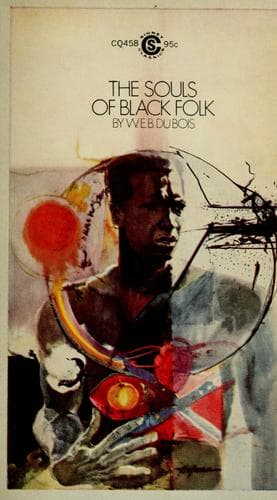
The Souls of Black FolkDu Bois, W. E. B. (William Edward Burghardt)
History
The Souls of Black Folk
Du Bois, W. E. B. (William Edward Burghardt)
African Americans
Fifty years ago the ability of Negro students in any appreciable
numbers to master a modern college course would have been difficult to
prove. To-day it is proved by the fact that four hundred Negroes, many
of whom have been reported as brilliant students, have received the
bachelor’s degree from Harvard, Yale, Oberlin, and seventy other
leading colleges. Here we have, then, nearly twenty-five hundred Negro
graduates, of whom the crucial query must be made, How far did their
training fit them for life? It is of course extremely difficult to
collect satisfactory data on such a point,—difficult to reach the men,
to get trustworthy testimony, and to gauge that testimony by any
generally acceptable criterion of success. In 1900, the Conference at
Atlanta University undertook to study these graduates, and published
the results. First they sought to know what these graduates were doing,
and succeeded in getting answers from nearly two-thirds of the living.
The direct testimony was in almost all cases corroborated by the
reports of the colleges where they graduated, so that in the main the
reports were worthy of credence. Fifty-three per cent of these
graduates were teachers,—presidents of institutions, heads of normal
schools, principals of city school-systems, and the like. Seventeen per
cent were clergymen; another seventeen per cent were in the
professions, chiefly as physicians. Over six per cent were merchants,
farmers, and artisans, and four per cent were in the government
civil-service. Granting even that a considerable proportion of the
third unheard from are unsuccessful, this is a record of usefulness.
Personally I know many hundreds of these graduates, and have
corresponded with more than a thousand; through others I have followed
carefully the life-work of scores; I have taught some of them and some
of the pupils whom they have taught, lived in homes which they have
builded, and looked at life through their eyes. Comparing them as a
class with my fellow students in New England and in Europe, I cannot
hesitate in saying that nowhere have I met men and women with a broader
spirit of helpfulness, with deeper devotion to their life-work, or with
more consecrated determination to succeed in the face of bitter
difficulties than among Negro college-bred men. They have, to be sure,
their proportion of ne’er-do-wells, their pedants and lettered fools,
but they have a surprisingly small proportion of them; they have not
that culture of manner which we instinctively associate with university
men, forgetting that in reality it is the heritage from cultured homes,
and that no people a generation removed from slavery can escape a
certain unpleasant rawness and gaucherie, despite the best of training.
Public-domain text, read in full here on John Shaqi.
Reviews
Reviews
No reviews yet
Be the first to share your thoughts on this work.
Elsewhere in the archive
Join the Discussion
Join the discussion
Sign in to leave a comment or review.
Sign InorCreate an account