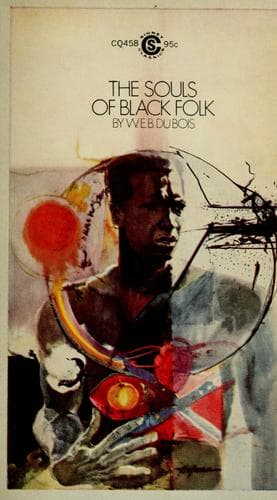
The Souls of Black FolkDu Bois, W. E. B. (William Edward Burghardt)
History
The Souls of Black Folk
Du Bois, W. E. B. (William Edward Burghardt)
African Americans
In such homes, then, these Negro peasants live. The families are both
small and large; there are many single tenants,—widows and bachelors,
and remnants of broken groups. The system of labor and the size of the
houses both tend to the breaking up of family groups: the grown
children go away as contract hands or migrate to town, the sister goes
into service; and so one finds many families with hosts of babies, and
many newly married couples, but comparatively few families with
half-grown and grown sons and daughters. The average size of Negro
families has undoubtedly decreased since the war, primarily from
economic stress. In Russia over a third of the bridegrooms and over
half the brides are under twenty; the same was true of the antebellum
Negroes. Today, however, very few of the boys and less than a fifth of
the Negro girls under twenty are married. The young men marry between
the ages of twenty-five and thirty-five; the young women between twenty
and thirty. Such postponement is due to the difficulty of earning
sufficient to rear and support a family; and it undoubtedly leads, in
the country districts, to sexual immorality. The form of this
immorality, however, is very seldom that of prostitution, and less
frequently that of illegitimacy than one would imagine. Rather, it
takes the form of separation and desertion after a family group has
been formed. The number of separated persons is thirty-five to the
thousand,—a very large number. It would of course be unfair to compare
this number with divorce statistics, for many of these separated women
are in reality widowed, were the truth known, and in other cases the
separation is not permanent. Nevertheless, here lies the seat of
greatest moral danger. There is little or no prostitution among these
Negroes, and over three-fourths of the families, as found by
house-to-house investigation, deserve to be classed as decent people
with considerable regard for female chastity. To be sure, the ideas of
the mass would not suit New England, and there are many loose habits
and notions. Yet the rate of illegitimacy is undoubtedly lower than in
Austria or Italy, and the women as a class are modest. The plague-spot
in sexual relations is easy marriage and easy separation. This is no
sudden development, nor the fruit of Emancipation. It is the plain
heritage from slavery. In those days Sam, with his master’s consent,
“took up” with Mary. No ceremony was necessary, and in the busy life of
the great plantations of the Black Belt it was usually dispensed with.
If now the master needed Sam’s work in another plantation or in another
part of the same plantation, or if he took a notion to sell the slave,
Sam’s married life with Mary was usually unceremoniously broken, and
then it was clearly to the master’s interest to have both of them take
new mates. This widespread custom of two centuries has not been
eradicated in thirty years. To-day Sam’s grandson “takes up” with a
Public-domain text, read in full here on John Shaqi.
Reviews
Reviews
No reviews yet
Be the first to share your thoughts on this work.
Elsewhere in the archive
Join the Discussion
Join the discussion
Sign in to leave a comment or review.
Sign InorCreate an account