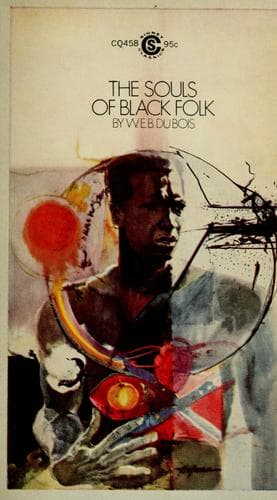
The Souls of Black FolkDu Bois, W. E. B. (William Edward Burghardt)
History
The Souls of Black Folk
Du Bois, W. E. B. (William Edward Burghardt)
African Americans
the fugitive, return him, and ask no questions. If he escape to another
county, a charge of petty thieving, easily true, can be depended upon
to secure his return. Even if some unduly officious person insist upon
a trial, neighborly comity will probably make his conviction sure, and
then the labor due the county can easily be bought by the master. Such
a system is impossible in the more civilized parts of the South, or
near the large towns and cities; but in those vast stretches of land
beyond the telegraph and the newspaper the spirit of the Thirteenth
Amendment is sadly broken. This represents the lowest economic depths
of the black American peasant; and in a study of the rise and condition
of the Negro freeholder we must trace his economic progress from the
modern serfdom.
Even in the better-ordered country districts of the South the free
movement of agricultural laborers is hindered by the migration-agent
laws. The “Associated Press” recently informed the world of the arrest
of a young white man in Southern Georgia who represented the “Atlantic
Naval Supplies Company,” and who “was caught in the act of enticing
hands from the turpentine farm of Mr. John Greer.” The crime for which
this young man was arrested is taxed five hundred dollars for each
county in which the employment agent proposes to gather laborers for
work outside the State. Thus the Negroes’ ignorance of the labor-market
outside his own vicinity is increased rather than diminished by the
laws of nearly every Southern State.
Similar to such measures is the unwritten law of the back districts and
small towns of the South, that the character of all Negroes unknown to
the mass of the community must be vouched for by some white man. This
is really a revival of the old Roman idea of the patron under whose
protection the new-made freedman was put. In many instances this system
has been of great good to the Negro, and very often under the
protection and guidance of the former master’s family, or other white
friends, the freedman progressed in wealth and morality. But the same
system has in other cases resulted in the refusal of whole communities
to recognize the right of a Negro to change his habitation and to be
master of his own fortunes. A black stranger in Baker County, Georgia,
for instance, is liable to be stopped anywhere on the public highway
and made to state his business to the satisfaction of any white
interrogator. If he fails to give a suitable answer, or seems too
independent or “sassy,” he may be arrested or summarily driven away.
Public-domain text, read in full here on John Shaqi.
Reviews
Reviews
No reviews yet
Be the first to share your thoughts on this work.
Elsewhere in the archive
Join the Discussion
Join the discussion
Sign in to leave a comment or review.
Sign InorCreate an account