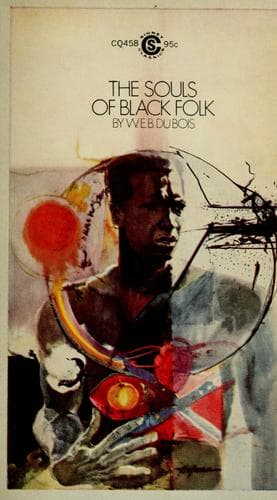
The Souls of Black FolkDu Bois, W. E. B. (William Edward Burghardt)
History
The Souls of Black Folk
Du Bois, W. E. B. (William Edward Burghardt)
African Americans
Now it happens that both master and man have just enough argument on
their respective sides to make it difficult for them to understand each
other. The Negro dimly personifies in the white man all his ills and
misfortunes; if he is poor, it is because the white man seizes the
fruit of his toil; if he is ignorant, it is because the white man gives
him neither time nor facilities to learn; and, indeed, if any
misfortune happens to him, it is because of some hidden machinations of
“white folks.” On the other hand, the masters and the masters’ sons
have never been able to see why the Negro, instead of settling down to
be day-laborers for bread and clothes, are infected with a silly desire
to rise in the world, and why they are sulky, dissatisfied, and
careless, where their fathers were happy and dumb and faithful. “Why,
you niggers have an easier time than I do,” said a puzzled Albany
merchant to his black customer. “Yes,” he replied, “and so does yo’
hogs.”
Taking, then, the dissatisfied and shiftless field-hand as a
starting-point, let us inquire how the black thousands of Dougherty
have struggled from him up toward their ideal, and what that ideal is.
All social struggle is evidenced by the rise, first of economic, then
of social classes, among a homogeneous population. To-day the following
economic classes are plainly differentiated among these Negroes.
A “submerged tenth” of croppers, with a few paupers; forty per cent who
are metayers and thirty-nine per cent of semi-metayers and
wage-laborers. There are left five per cent of money-renters and six
per cent of freeholders,—the “Upper Ten” of the land. The croppers are
entirely without capital, even in the limited sense of food or money to
keep them from seed-time to harvest. All they furnish is their labor;
the land-owner furnishes land, stock, tools, seed, and house; and at
the end of the year the laborer gets from a third to a half of the
crop. Out of his share, however, comes pay and interest for food and
clothing advanced him during the year. Thus we have a laborer without
capital and without wages, and an employer whose capital is largely his
employees’ wages. It is an unsatisfactory arrangement, both for hirer
and hired, and is usually in vogue on poor land with hard-pressed
owners.
Public-domain text, read in full here on John Shaqi.
Reviews
Reviews
No reviews yet
Be the first to share your thoughts on this work.
Elsewhere in the archive
Join the Discussion
Join the discussion
Sign in to leave a comment or review.
Sign InorCreate an account