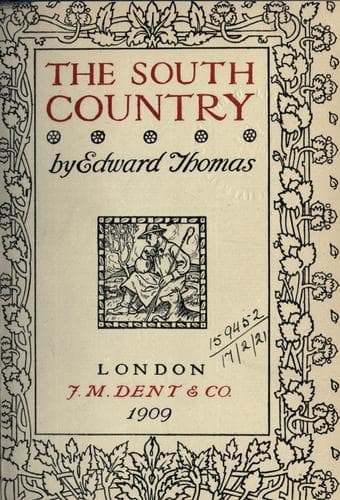
England -- Description and travel; Natural history -- England; Thomas, Edward, 1878-1917 -- Travel -- England
“Then my old woman--well, she was only a bit of a wench too; seventeen
when we were married--she took ill and died within a week after....
There was a purpose in it.... It was then the end of harvest. I spent
all my wages down at the Fighting Cocks, and then I set out to walk
to Mildenhall in Wiltshire, where my wife came from. On the way I met
a chap I had quarrelled with in Egypt, and he says to me, ‘Hullo,
Scrammy-handed Jack,’ with a sort of look, and I, not thinking what I
did, I set about him, and before I knew it he was lying there as might
be dead, and I went and gave myself up, and I don’t mind saying that I
wished I might be hanged for it. However, I did six months. That was
how I came to be in the umbrella line. I took up with a chap who did a
bit of tinkering and umbrella-mending and grinding in the roving way,
and a job of hoeing or mowing now and then. He died not so very long
after in the year of the siege of Paris, and I have been alone ever
since. Nor I haven’t been to church since, any more than a blackbird
would go and perch on the shoulder of one of those ladies with feathers
and wings and a bit of a fox in their hats.”
Labourer, soldier, labourer, tinker, umbrella man, he had always
wandered, and knew the South Country between Fordingbridge and Dover
as a man knows his garden. Every village, almost every farmhouse,
especially if there were hops on the land, he knew, and could see with
his blue eyes as he remembered them and spoke their names. I never
met a man who knew England as he did. As he talked of places his eyes
were alight and turned in their direction, and his arm stretched out
to point, moving as he went through his itinerary, so that verily,
wherever he was, he seemed to carry in his head the relative positions
of all the other places where he had laboured and drunk and lit his
solitary fire. “Was you ever at H----?” he said, pointing to the Downs,
through which he seemed to see H---- itself. “General ----, that
commanded us, lived there. He died there three years ago at the age of
eighty-eight, and till he died I was always sure of a half-crown if I
called there on a Christmas Eve, as I generally managed to do.” Of any
place mentioned he could presently remember something significant--the
words of a farmer, a song, a signboard, a wonderful crop, the good
ale--the fact that forty-nine years ago the squire used to go to church
in a smock frock. All the time his face was moved with free and broad
expressions as he thought and remembered, like an animal’s face. Living
alone and never having to fit himself into human society, he had not
learnt to keep his face in a vice. He was returning--if the grave was
not too near at the age of seventy-seven--to a primeval wildness and
simplicity. It was a pleasure to see him smoke--to note how it eased
his chest--to see him spit and be the better for it. The outdoor life
had brought him rheumatism, but a clear brain also and a wild purity, a
Public-domain text, read in full here on John Shaqi.
Reviews
Reviews
No reviews yet
Be the first to share your thoughts on this work.
Elsewhere in the archive
Join the Discussion
Join the discussion
Sign in to leave a comment or review.
Sign InorCreate an account