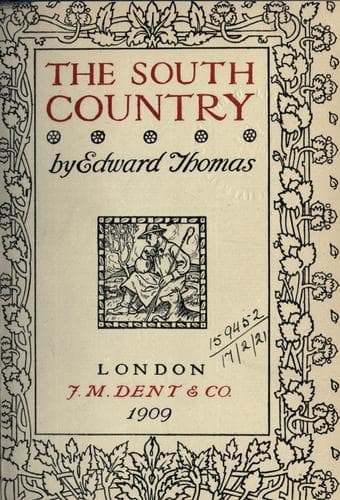
England -- Description and travel; Natural history -- England; Thomas, Edward, 1878-1917 -- Travel -- England
The man who lives under that roof and was born there seventy years ago
is like his house. He is short and immensely broad, black-haired, with
shaved but never clean-shaven face creased by a wide mouth and long,
narrow black eyes--black with a blackness as of cold, deep water that
had never known the sun but only the candle-light of discoverers. His
once grey corduroys and once white slop are stained and patched to
something like the colour of the moist, channelled thatch and crumbling
“clunch” of the stone walls. He wears a soft felt hat with hanging
broad brim of darker earthy hues; it might have been drawn over his
face and ears in his emergence from his native clay and flint. Only
rarely does his eye--one eye at a time--gloom out from underneath,
always accompanied by a smile that slowly puckers the wrinkled oak-bark
of his stiff cheeks. His fingers, his limbs, his face, his silence,
suggest crooked oak timber or the gnarled stoles of the many times
polled ash. It is barely credible that he grew out of a child, the son
of a woman, and not out of the earth itself, like the great flints that
work upwards and out on to the surface of the fields. Doubtless he did,
but like many a ruined castle, like his own house, he has been worn to
a part of the earth itself. That house he will never give up except by
force, to go to workhouse or grave. They want him to go out for a few
days that it may be made more weather-tight; but he fears the chances
and prefers a rickety floor and draughty wall. He is half cowman, half
odd-job man--at eight shillings a week--in his last days, mending
hedges, cleaning ditches, and carrying a sack of wheat down the steep
hill on a back that cannot be bent any farther. Up to his knees in the
February ditch, or cutting ash-poles in the copse, he is clearly half
converted into the element to which he must return.
When the underwood is for sale it is a pleasure to read the notices
fixed to the doors of barn and shed, with the names of the copses and
woods. At Penshurst lately, for example, I saw these names--
Black Hoath Wood.
Heronry Pond.
Marlpit Field.
Tapner’s Wood.
Ashour Farm.
Sidney’s Coppice.
Weir Field.
Well Place.
I was back in Sidney’s time, remembering that genial poem of Ben
Jonson’s, “To Penshurst,” and especially the lines--
“Thy copse too, named of Gamage, thou hast there,
That never fails to serve thee season’d deer,
When thou wouldst feed or exercise thy friends.
The lower land, that to the river bends,
Thy sheep, thy bullocks, kine, and calves do feed;
The middle grounds thy mares and horses breed.
Each bank doth yield thee conies; and the tops
Fertile of wood, Ashore and Sidney’s copps,
To crown thy open table, doth provide
The purple pheasant with the speckled side, ...”
and so onward to that opulence and ease three centuries old--
Public-domain text, read in full here on John Shaqi.
Reviews
Reviews
No reviews yet
Be the first to share your thoughts on this work.
Elsewhere in the archive
Join the Discussion
Join the discussion
Sign in to leave a comment or review.
Sign InorCreate an account