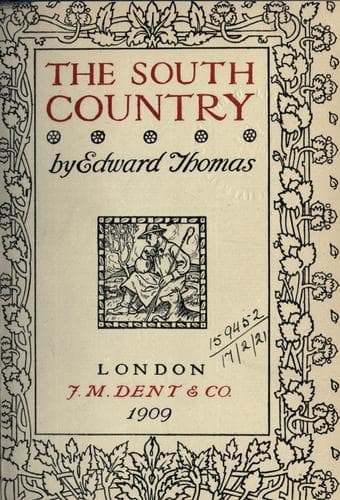
England -- Description and travel; Natural history -- England; Thomas, Edward, 1878-1917 -- Travel -- England
The oats have been trampled by rain, and two men are reaping it by
hand. They are not men of the farm, but rovers who take their chance
and have done other things than reaping in their time. One is a
Hampshire man, but fought with the Wiltshires against “Johnny Boer”--he
liked the Boers ... “they were very much like a lot of working men....
We never beat ’em.... No, we never beat ’em.” He is a man of heroic
build; tall, lean, rather deep-chested than broad-shouldered, narrow in
the loins, with goodly calves which his old riding breeches perfectly
display; his head is small, his hair short and crisp and fair, his
cheeks and neck darkly tanned, his eye bright blue and quick-moving,
his features strong and good, except his mouth, which is over large
and loose; very ready to talk, which he does continually in a great
proud male voice, however hard he is working. A man as lean and hard
and bright as his reaping hook. First he snicks off a dozen straws
and lays them on the ground for a bond, then he slashes fast along
the edge of the corn for two or three yards, gathers up what is cut
into his hook and lays it across the straws: when a dozen sheaves are
prepared in the same way he binds them with the bonds and builds them
into a stook of two rows leaning together. It is impossible to work
faster and harder than he does in cutting and binding; only at the
end of each dozen sheaves does he stand at his full height, straight
as an ash, and laugh, and round off what he has been saying even more
vigorously than he began it. Then crouching again he slays twelve other
sheaves. Then he goes over to the four-and-a-half-gallon cask in the
hedge: it is a “fuel” that he likes, and he pays for it himself. In
his walk and attitude and talk--except in his accent--there is little
of the countryman. He is a citizen of the world, without wife or home
or any tie except to toil--and after that pleasure--and toil again. A
loose bold liver--and lover--there can be no doubt. The spirit of life
is strong in him, in limbs and chest and eyes and brain, the spirit
which compels one man to paint a picture, one to sacrifice his life
for another, one to endure poverty for an idea, another to commit a
murder. What is there for him--to be the mark for a bullet, to contract
a ravenous disease, to bend slowly under the increasing pile of years,
of work, of pleasures? He does not care. He is always seeing “a bit of
life” from town to town, from county to county, a peerless fleshly man
casting himself away as carelessly as Nature cast him forth into the
world. His father before him was the same, ploughboy, circus rider,
brickmaker, and day labourer again on the land, one who always “looked
for a policeman when he had had a quart.” He set out on his travels
again and disappeared. His wife went another way, and she is still to
be met with in the summer weather, not looking as if she had ever borne
such a son as this reaper. As she grows older she seems to stretch out
Public-domain text, read in full here on John Shaqi.
Reviews
Reviews
No reviews yet
Be the first to share your thoughts on this work.
Elsewhere in the archive
Join the Discussion
Join the discussion
Sign in to leave a comment or review.
Sign InorCreate an account