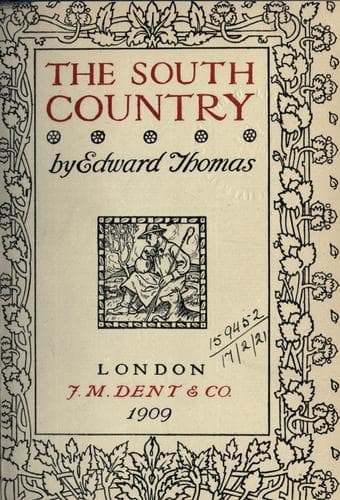
England -- Description and travel; Natural history -- England; Thomas, Edward, 1878-1917 -- Travel -- England
This beautiful house under the Downs was already more than “sand and
stone.” It was a giant, very gentle but very powerful, and adding to
its power the lore of the family it was irresistible. This young mother
had all the lore by heart and loved it, yet had fought against it. She
had been happy when her child had grown at first unlike her own family
and much like her husband’s; but no! his hair grew lighter, his nose
was as those of her brothers’ in bud, and now that he was five he was
not a child so much as an incarnation of the family, a sort of graven
image to which the old man bowed down, and with all the more fervour
because of that weakness in the boy which others thought imbecility.
The old man, too, had been not only a man but a family; now that the
child was there he waited, garrulously contented, for his release from
the post. So contented was he that when the granddaughter left her
child with him, and after delays and excuses and delays disappeared
into the blank, indifferent abyss of the multitude far away who knew
not the house and the family, he was not only contented but glad at
heart, for it was a rebel that was gone.
For several years the white beard and the poor child lived together
happily, turning over old memories, old books, old toys, taking the old
walks through the long garden, past, but not into, the beech wood that
a whim of the old man’s had closed against even himself, against all
save the birds and the squirrels; over the high downs and back into the
deep vale which had produced that delicate physical beauty and those
gracious lusty ways beyond which it seemed that men and women could
hardly go in earthly life. Very happy were those two, and very placid;
but within a week their tragic peace was perfected. The boy fell out
of one of the apple-trees and was killed. The old man could not but
stumble over that small grave into his own, and here is the end, the
unnoted, the common end, and the epitaph written by the auctioneer and
the rain.
Much as I love rain, heavy or light, freakish or continuous, I am glad
to be out of it for a little while and to open a book of ballads by a
solitary fire at “The White Horse,” and soon to close it after reading
again the lines--
“O then bespake her daughter dear,
She was baith jimp and sma’:
‘O row me in a pair o’ sheets,
And tow me owre the wa’!’
They row’d her in a pair o’ sheets,
And tow’d her owre the wa’;
But on the point o’ Gordon’s spear
She gat a deadly fa’.
O bonnie, bonnie was her mouth,
And cherry were her cheeks,
And clear, clear was her yellow hair,
Whereon the red blood dreeps.
Then wi’ his spear he turn’d her owre;
O gin her face was wan!
He said, ‘Ye are the first that e’er
I wish’d alive again.’
He cam’ and lookit again at her;
O gin her skin was white!
‘I might hae spared that bonnie face
To hae been some man’s delight.
Public-domain text, read in full here on John Shaqi.
Reviews
Reviews
No reviews yet
Be the first to share your thoughts on this work.
Elsewhere in the archive
Join the Discussion
Join the discussion
Sign in to leave a comment or review.
Sign InorCreate an account