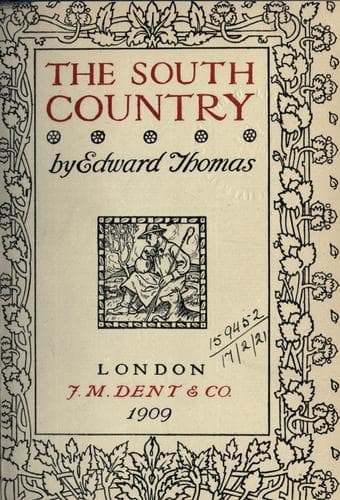
England -- Description and travel; Natural history -- England; Thomas, Edward, 1878-1917 -- Travel -- England
Not far from “The White Horse” is a little town upon a stream that
waves myriads of reeds and tall purple flowers of hemp agrimony. These
are the last shops I am likely to pass in Wiltshire, and it occurs
to me that I should like to taste lardy cakes--which I last bought
in Wroughton fifteen years ago--before I leave the county. Richard
Jefferies’ grandfather was “My Lord Lardy Cake” in old Swindon sixty
years ago, and his memory is kept alive by those tough, sweet slabs
of larded pastry which, in his generous ovens, gathered all the
best essences of the other cakes, pies, tarts and joints which were
permitted to be baked with them. In “Amaryllis at the Fair” they are
mentioned with some indignity as a ploughboy’s delicacy. My lips water
for them, and at the first bakery in ---- I ask for some. The baker
tells me he has sold the last one. He is a small, white-haired and
white-bearded man with an expression of unctuous repose, assuredly
a pillar of his chapel and possibly its treasurer, and though he
himself will, by his own telling, have no more lardy cakes until
the next morning, he stiffly tries to persuade me that none of his
fellow-townsmen bakes them. I disbelieve the man of dough for all his
conscious look of sagacity and virtue, and am rewarded for my disbelief
by four lardy cakes for threepence-halfpenny not many yards from his
accursed threshold. Lardy cakes, I now discover for the first time,
have this merit besides their excellent taste and provision of much
pleasant but not finical labour for the teeth, that one is enough at a
time, and that four will, therefore, take a man quite a long way upon
the roads of England.
* * * * *
At the next inn three labourers and the landlord are heated in
conversation about some one not present.
“Quite right,” says one, a sober carter whose whip leans against the
counter, “’tis the third time this week that a tramp has been to his
door, and by the looks of them they didn’t call for naught.”
“One of them didn’t, I know,” says the landlord. “He came in here once
and asked for a job and left without a drink, but after he’d been to
Stegbert’s Cottage he came straight here and ordered a pint of mild.
And I heard as he let a chap and a woman sleep two nights running in
that rough patch behind the house. Don’t you think the parson ought to
hear of that? And what does he do for a living? He looks poor enough
himself.”
“I don’t know. Mr. Jones is a kind-hearted fellow. He stopped my
youngest in the street the other day and gave her a penny and measured
her hair, and told her she’d have a yard of it some day. They tell me
he hasn’t a carpet on the floor anywhere, and no parlour, and not even
a chest of drawers; and the postman says he hasn’t a watch or a clock.
What does he do with himself?”
Public-domain text, read in full here on John Shaqi.
Reviews
Reviews
No reviews yet
Be the first to share your thoughts on this work.
Elsewhere in the archive
Join the Discussion
Join the discussion
Sign in to leave a comment or review.
Sign InorCreate an account