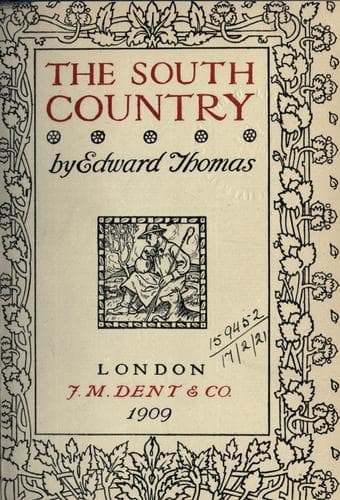
England -- Description and travel; Natural history -- England; Thomas, Edward, 1878-1917 -- Travel -- England
Some day there will be a history of England written from the point of
view of one parish, or town, or great house. Not until there is such a
history will all our accumulations of information be justified. It will
begin with a geological picture, something large, clear, architectural,
not a mass of insignificant names. It must be imaginative: it might,
perhaps, lean sometimes upon Mr. Doughty’s _Dawn in Britain_. The
peculiar combination of soil and woodland and water determines the
direction and position and importance of the ancient trackways; it will
determine also the position and size of the human settlements. The
early marks of these--the old flint and metal implements, the tombs,
the signs of agriculture, the encampments, the dwellings--will have to
be clearly described and interpreted. Folk-lore, legend, place-names
must be learnedly, but bravely and humanly used, so that the historian
who has not the extensive sympathy and imagination of a great novelist
will have no chance of success. What endless opportunities will he have
for really giving life to past times in such matters as the line made
by the edge of an old wood with the cultivated land, the shapes of the
fields, with their borders of streams or hedge or copse or pond or wall
or road, the purpose and interweaving of the roads and footpaths that
suggest the great permanent thoughts and the lesser thoughts and dreams
of the brain.... As the historic centuries are reached, the action of
great events, battles, laws, roads, invasions, upon the parish--and of
the parish upon them--must be shown. Architecture, with many of its
local characteristics still to be traced, will speak as a voice out of
the stones of castle, church, manor, farm, barn and bridge. The birds
and beasts cannot be left out. The names of the local families--gentle
and simple--what histories are in them, in the curt parish registers,
in tombstones, in the names of fields and houses and woods. Better a
thousand errors so long as they are human than a thousand truths lying
like broken snail-shells round the anvil of a thrush. If only those
poems which are place-names could be translated at last, the pretty,
the odd, the romantic, the racy names of copse and field and lane and
house. What a flavour there is about the Bassetts, the Boughtons,
the Worthys, the Tarrants, Winterbournes, Deverills, Manningfords,
the Suttons: what goodly names of the South Country--Woodmansterne,
Hollingbourne, Horsmonden, Wolstanbury, Brockenhurst, Caburn, Lydiard
Tregoze, Lydiard Millicent, Clevancy, Amesbury, Amberley (I once tried
to make a beautiful name and in the end it was Amberley, in which Time
had forestalled me); what sweet names Penshurst, Frensham, Firle,
Nutley, Appleshaw, Hambledon, Cranbrook, Fordingbridge, Melksham,
Lambourn, Draycot, Buscot, Kelmscot, Yatton, Yalding, Downe, Cowden,
Iping, Cowfold, Ashe, Liss.... Then there are the histories of roads.
Every traveller in Hampshire remembers the road that sways with airy
Public-domain text, read in full here on John Shaqi.
Reviews
Reviews
No reviews yet
Be the first to share your thoughts on this work.
Elsewhere in the archive
Join the Discussion
Join the discussion
Sign in to leave a comment or review.
Sign InorCreate an account