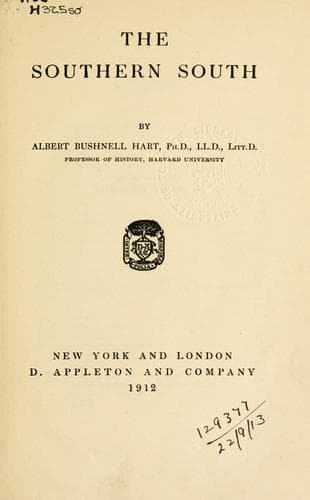
Southern States -- Social conditions; United States -- Race relations
Some Southern authorities assert that race hatred was fomented toward the
end of Reconstruction. Says "Nicholas Worth": "Men whose faithful servants
were negroes, negroes who had shined their shoes in the morning and cooked
their breakfasts and dressed their children and groomed their horses and
driven them to their offices, negroes who were the faithful servants and
constant attendants on their families,--such men spent the day declaring
the imminent danger of negro 'equality' and 'domination.'" The same genial
writer goes on to describe the gloom at the supposed flood of African
despotism; they said: "Our liberties were in peril; our very blood would
be polluted; dark night would close over us,--us, degenerate sons of
glorious sires,--if we did not rise in righteous might and stem the
barbaric flood." Though in all the states the Negroes were swept out of
political power by 1876, to this day they are popularly supposed to be
planning some kind of domination over the Whites. This made-up race issue
is not yet extinct. Nobody knows the inner spirit of a certain section of
the South better than Thomas E. Watson, of Georgia, who has recently said:
"The politicians keep the negro question alive in the South to perpetuate
their hold on public office. The negro question is the joy of their lives.
It is their very existence. They fatten on it. With one shout of 'nigger!'
they can run the native Democrats into their holes at any hour of the
day."
How does this feeling strike the Negro? Let an intelligent man, Johnson,
in his "Light Ahead for the Negro," speak for himself. He complains that
the newspapers use inflammatory headlines and urge lynchings--"a wholesale
assassination of Negro character"; that it is made a social crime to
employ Negroes as clerks in a white store; that the cultured Southern
people spread abroad the imputation that the Negro as a race is worthless;
that the news agents are prejudiced against the Negro and give misleading
accounts of difficulties with the Whites; that people thought to be
friendly are hounded out of their positions; that there is a desire to
expatriate the negroes from the country of their fathers. Kelly Miller, a
professor in Howard University, Washington, objects to using physical
dissimilarity as a mark of inferiority, and thinks "that the feeling
against the negro is of the nature of inspirited animosity rather than
natural antipathy"; and that "the dominant South is determined to foster
artificial hatred between the races."
Public-domain text, read in full here on John Shaqi.
Reviews
Reviews
No reviews yet
Be the first to share your thoughts on this work.
Elsewhere in the archive
Join the Discussion
Join the discussion
Sign in to leave a comment or review.
Sign InorCreate an account