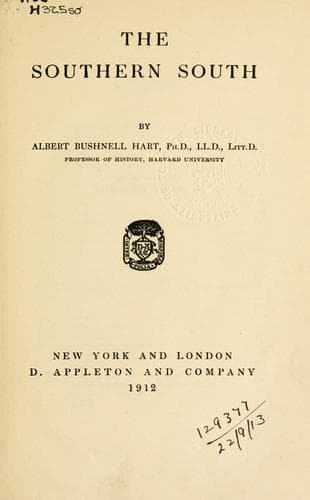
Southern States -- Social conditions; United States -- Race relations
The principle of race separation extends from civil into religious
matters. Before the Civil War Negroes were often acceptable and honored
members of white churches, and there are still some cases where old
members continue this relation, but they could now hardly sit in the same
pews. There are also difficulties in attempts to unite separate black and
white churches into one general denomination. The Protestant Episcopal
Church is much perplexed over a proposition for separate negro bishops,
inferior to the regular bishops. However, not a twentieth of the Negroes
to-day are members of churches which are in organic relation to white
churches; they have their own presbyteries, and conferences, and synods;
set their own doctrines and moral standards, and (if the white man is
right in thinking the race inferior) they will necessarily develop an
inferior Christianity.
The discriminations so far mentioned have to do with unwritten practices;
with customs which differ from community to community; there is another
long series upon the statute books. In 1865, in the so-called Vagrant
Laws, special provision was made for the relations of colored people; four
states allowed colored children to be "apprenticed," which practically
meant a mild slavery; in South Carolina "servants," as the Negroes were
called in the statute, were forbidden to leave their master's place
without consent; Mississippi forbade people to rent land to Negroes
outside the towns; South Carolina established a special court for the
trial of negro offenses; several states forbade blacks to practice any
trade or business without a license. These laws, which competent
Southerners now think to have been a serious mistake, seemed to Congress
evidence of a purpose to restore a milder form of slavery, and they were
swept away by the Reconstruction governments. Nevertheless, in all the
Southern states, constitutions or statutes forbid the intermarriage of
Whites and Negroes; and either during Reconstruction or since, all the
Southern states have provided for separate public schools for Negroes; and
several states prohibit the education of Whites and blacks in the same
private school.
Public-domain text, read in full here on John Shaqi.
Reviews
Reviews
No reviews yet
Be the first to share your thoughts on this work.
Elsewhere in the archive
Join the Discussion
Join the discussion
Sign in to leave a comment or review.
Sign InorCreate an account