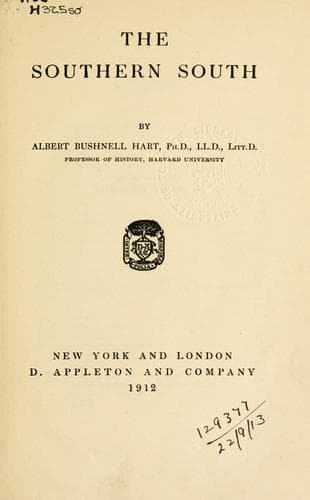
Southern States -- Social conditions; United States -- Race relations
These discriminations on travel have never been desired by the railroad
companies, inasmuch as they involve trouble and expense, and are a check
on the Negro's love for riding on trains and boats, which is an important
factor in the passenger receipts. It is everywhere disliked by the
Negroes, both because they do not, in fact, have accommodations as good as
those of the Whites, and because it is intended to be a mark of their
inferiority. The low-class white man who, in 1902, acted as ticket agent,
baggage man and division superintendent and conductor on the three-mile
branch road connecting Tuskegee with the main line remarked affably: "Been
to see the nigger school, I suppose? That's all right, Booker Washington's
all right. Oh, yes, he's a good man, he often rides on this train. Not in
this part of the car, you know, but over there in the Jim Crow. Oh, yes, I
often set down and talk to Booker Washington. Not on the same seat of
course. Jest near by."
Besides these shackles of custom or of law, the Negro is in general
excluded in the South from every position which might be construed to give
him authority over white people. The civil service of the federal
government is on a different footing; ever since war times there have
always been some negro federal officials, collectors of internal revenue,
collectors of ports, postmasters, and the like; but there is a determined
effort in the South to get rid of them. At Lake City, S. C., in 1898, part
of the family of Baker, the negro postmaster, was massacred as a hint that
his presence was not desired. The people of Indianola, Miss., in 1903,
practically served notice on a colored postmistress that she could not be
allowed to officiate any longer; whereupon President Roosevelt directed
the closing of the Indianola office. When in 1902 Dr. Crum was appointed
collector of Charleston, there was an uproar in South Carolina and
throughout the South. That episode involved some painful and some comical
things; for instance, a white lady who bears one of the most honored names
in American history, and who sorely needed the employment, was practically
compelled by public sentiment to resign a clerkship in the customhouse
when Dr. Crum came in; and the people who protested against his
appointment, on the ground that he was unfit, had previously helped to
select him as a commissioner in the Charleston Exposition.
In all these controversies the issue was double; first, that the white
people thought it an indignity to transact any public business with a
Negro representing the United States; and second, that it would somehow
bring about race equality to admit that a Negro was competent to hold any
important office. The President was furiously censured because he did not
take into account the preferences of the Southern people, by which, of
course, was meant the Southern white people; that in South Carolina there
are more African citizens than Caucasian seemed to them quite beside the
question.
Public-domain text, read in full here on John Shaqi.
Reviews
Reviews
No reviews yet
Be the first to share your thoughts on this work.
Elsewhere in the archive
Join the Discussion
Join the discussion
Sign in to leave a comment or review.
Sign InorCreate an account