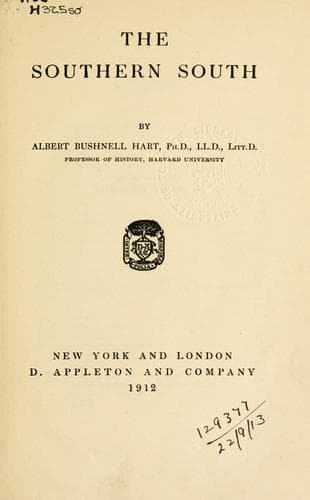
Southern States -- Social conditions; United States -- Race relations
The discrimination between the Negro and the White has nowhere been so
bitterly contested as with regard to suffrage, inasmuch as the right of
the Negro to vote on equal terms with the white man is distinctly set
forth in the Fifteenth Amendment of the Federal Constitution, and as
during Reconstruction the Negro had full suffrage in all the Southern
states. Without going into the history of the negro vote, it may be worth
while to notice that at the time of the Revolution, Negroes who had the
property qualification could vote in all the thirteen colonies except two;
that they never lost that franchise in Massachusetts and some other
Northern communities, and that as late as 1835 about a thousand of them
had the ballot in North Carolina. Then in Reconstruction times the
suffrage was given to all the Negroes in the country; a process of which
one of the most bitter enemies of the race to-day says: "To give the negro
the right of suffrage and place him on terms of absolute equality with the
white man, was the capital crime of the ages against the white man's
civilization." In reality the North bestowed the suffrage on the Negro
because its own experience seemed to have proved that the ballot was an
instrument of civilization--for all the foreign immigrants had grown up to
it.
Southerners are never weary of describing the enormities of the
governments based on negro suffrage; as a matter of fact, however, nobody
North or South knows what would have been the result of negro suffrage,
for in no state longer than eight years, and in some states only about
three years, did they actually cast votes that determined the choice of
state officers, or any considerable number of local officers. Their habit
of voting for "the regular candidate," without regard to his fitness or
character, was not peculiar to the race or to the section.
Disfranchisement began with the Ku Klux in 1870, and in most states the
larger part of the Negroes at once lost their ballots because driven away
from the polls by violence or terror. The only community in which they
were disfranchised by statute, together with the Whites, was the District
of Columbia. Then came the era of fraud, the use of tissue ballots and
falsified electoral returns, and confusing systems of ballot boxes; then,
in 1890, began a process of disfranchising them by state constitutional
amendments which provided qualifications especially difficult for Negroes
to meet: for instance, special indulgence was given to men who served in
the Confederate army, or whose fathers or grandfathers were entitled to
vote before the war. This movement has already involved six states, and is
likely to run through every former slaveholding state.
Public-domain text, read in full here on John Shaqi.
Reviews
Reviews
No reviews yet
Be the first to share your thoughts on this work.
Elsewhere in the archive
Join the Discussion
Join the discussion
Sign in to leave a comment or review.
Sign InorCreate an account