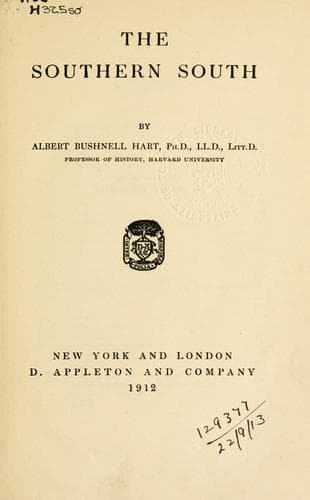
Southern States -- Social conditions; United States -- Race relations
Whatever the divergences of feeling in the South on the negro question, it
is safe to say that the Whites are a unit on the two premises that
amalgamation must be resisted, and that the Negro must not have political
power. All these feelings are buttressed against a passionate objection
to race-mixture, which is all the stronger because so much of it is going
on; it branches out into the withdrawal of the suffrage, not because the
South is in any danger of negro political domination, but because most
Whites think no member of an inferior race ought to vote; it includes many
restrictions on personal relations which seem like precautions where there
is no danger.
Upon these main issues Northerners may share some of the sentiments of the
South, but none of the terrors. If the Negro is inferior, it does not need
so many acts of the legislature to prove it; if amalgamation is going on,
it is due to the white race, can be checked by the white race, and by no
one else; if the Negro is unintelligent, he will never, under present
conditions, get enough votes to affect elections; if he does acquire the
necessary property and education, he thereby shows that he does not share
in the inferiority of his race. The South thinks about the Negro too much,
talks about him too much, abuses him too much. In the nature of things
there is no reason why the superior and the inferior race may not live
side by side indefinitely. Is the Negro powerful enough to force his
standards and share his disabilities with the superior white man? Is it
not as the Chinese sage says: "The superior man is correctly firm, and not
firm merely ... what the superior man seeks is in himself."
So far as can be judged, the average frame of mind in the South includes
much injustice, and unwillingness to permit the negro race to develop up
to the measure of its limitations. Here the experience of the North
counts, for it has many elements of population which at present are
inferior to the average. If there is a low Italian quarter in a city, or a
Slav quarter, or a Negro quarter, the aim of the Northern community is to
give those people the best chance that they can appropriate. Woe to the
city which permits permanent centers of crime and degradation! By schools,
by reformatory legislation, by philanthropic societies, by juvenile
courts, by missions, by that great blessing, the care of neglected
children, they try to bring up the standard. This is done for the welfare
of the community, it is what business men call a dollars and cents
proposition. If a man or child has three fourths of the average abilities,
the North tries to bring him to the full use of his seventy-five per cent;
if he stands at 150 on the scale of 100, it aims to give him the
opportunity to use his superior qualities.
Public-domain text, read in full here on John Shaqi.
Reviews
Reviews
No reviews yet
Be the first to share your thoughts on this work.
Elsewhere in the archive
Join the Discussion
Join the discussion
Sign in to leave a comment or review.
Sign InorCreate an account