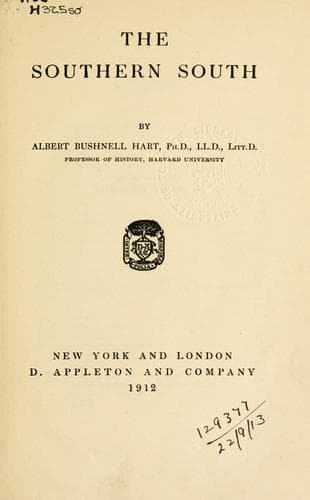
Southern States -- Social conditions; United States -- Race relations
To say that the Negroes furnish more than their proportion of criminals is
no more than to say that the lowest element in the population has the
lowest and most criminal members. The excessive criminality of the
Negroes, which is marked in all the states of the Union, is of course a
mark of their average inferiority, and a measure of the difficulty of
bringing them up to a high standard; and the proportion is often
exaggerated. In South Carolina where the Negroes are three fifths of the
population they furnish only four fifths of the convicts. As for the
assertion that the educated Negroes are specially criminal, the statement
is contradicted by the records of the large institutions of negro
education, and by the experience of thousands of people. Education does
not necessarily make virtue, but it is a safeguard. As a matter of fact,
white Southerners in general know little of the lives or motives of
thousands of the immense noncriminal class of Negroes, with whom they have
no personal relations; but are wide awake to the iniquities of the
educated men who fall into crime.
The experience of two centuries shows that the Negroes are not drawn to
crimes requiring previous organization and preparation; no slave
insurrection has ever been a success within the boundaries of the United
States; and blacks are rarely found in gangs of bandits. The incendiarism
of which there is now so much complaint is probably the expression of
individual vengeance. The Negroes, according to the testimony of those
nearest to them, are inveterate gamblers, and many affrays result from
consequent quarrels, so that murders may be most frequent where there is
the best employment and largest wages and greatest prosperity among the
thrifty. Murder, manslaughter, and attempts to kill make up three quarters
of the recorded crimes of the blacks in the Mississippi Delta. Murders of
Negroes by Negroes are very common and many of the criminals escape
altogether.
Negro crime is much fomented by the low drinking-shops in the city and in
country, by the lack of home influence on growing boys and girls, by the
brutalizing of young people who are sent to prison with hardened
criminals, and in general, by close contact with the lowest element of the
white race, which leads to crimes on both sides. It is a striking fact
that where the Africans are most numerous there is the least complaint of
crime. The so-called race riots are usually rows between a few bad Negroes
and the officers of the law, or a group of aggrieved Whites. Fights with
policemen and sheriffs are frequent, and desperate men not infrequently
barricade themselves in houses, and sell their lives as dearly as they
can. Quarrels over the settlement of accounts are not uncommon, and the
Negro who feels himself cheated sometimes takes his revenge at the end of
a gun. As weapons are ordinarily sold without the slightest check, to men
of both races and of every age, there is never any lack of the means to
kill.
Public-domain text, read in full here on John Shaqi.
Reviews
Reviews
No reviews yet
Be the first to share your thoughts on this work.
Elsewhere in the archive
Join the Discussion
Join the discussion
Sign in to leave a comment or review.
Sign InorCreate an account