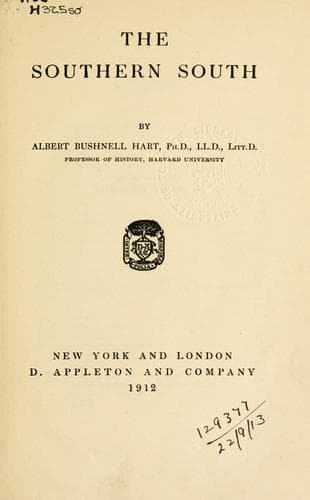
Southern States -- Social conditions; United States -- Race relations
The whole subject is complicated with vagrant laws. For instance, in
Savannah Negroes not at work, or without reasonable excuse for idleness,
shall be arrested; and in Alabama if arrested as a vagrant the burden of
proof is on the black to show that he is at work. It is a mistake to
suppose that colored tramps are common in the South; but irresponsible
men, loitering about a city and sponging on the working Negroes, are
frequent, and furnish many serious criminals.
On the whole, one would rather not be a negro convict in a Southern state,
or even a white convict, for many state and county prisons are simply
left-over examples of the worst side of slavery. A Northern expert in such
matters in Atlanta a few years ago, in a public address, congratulated the
people on the new jail which he had just visited. At least it looked like
the most improved of modern jails, for it had large airy cells provided
with running water, and the only defect in it was that it was intended for
the state mules and was far better than any provision made there for human
prisoners.
The first trouble with the Southern convict system is that it still
retains the notion, from which other communities began to diverge nearly a
century ago, that the prisoner is the slave of the state, existing only
for the convenience and profit of those whom he serves. In the second
place, it has been difficult to find indoor employment for the men, and
most of them are worked out of doors, a life which with proper precautions
is undoubtedly happier and healthier than that inside. In the third place,
whipping is still an ordinary penalty, and very frequently applied.
Furthermore, a number of states in the Lower South have been in the habit
of letting out convicts, and that is still done in several states, as
Florida, Alabama, and Georgia. They used to be rented to cotton growers,
and a planter could get as few as two convicts or even one, over whom he
had something approaching the power of life and death. This was a virtual
chattel slavery, which long ago ought to have been disallowed by the
Supreme Court of the United States, as contrary to the Thirteenth
Amendment. If still retained on a state or county plantation, the convicts
are in the power of wardens whose interest it is to drive the men
unmercifully. Governor Vardaman in a public message in 1908 thought it
necessary to say that "Some of the most atrocious and conscienceless
crimes that have been perpetrated in this State are chargeable to the
county contractor. I have known the poor convict driven to exhaustion or
whipped to death to gratify the greed or anger of the conscienceless
driver or contractor. The tears and blood of hundreds of these unfortunate
people cry out for this reform."
Public-domain text, read in full here on John Shaqi.
Reviews
Reviews
No reviews yet
Be the first to share your thoughts on this work.
Elsewhere in the archive
Join the Discussion
Join the discussion
Sign in to leave a comment or review.
Sign InorCreate an account