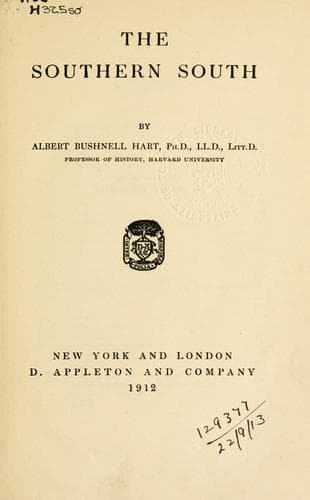
Southern States -- Social conditions; United States -- Race relations
Except the Pacific Northwest no part of the Union is so rich in timber as
the South. Until about ten years ago, enormous areas of timber land were
so far from railroads that nobody could think of lumbering them; now that
the hills of Louisiana, Mississippi, Alabama, Georgia, and the Carolinas
are penetrated with main lines, now that branches are pushed out and that
logging trams stretch still farther, few spots lie more than fifteen miles
from rails. Before sawmills arrive, men can earn fair day wages at cutting
railway ties and hauling them as much as fifteen miles, so that the poor
land-owners have one unfailing cash resource. Up to the financial
depression of 1907, lumbering of every kind was very prosperous; new mills
were under construction and a large amount of labor found employment. In
1908 many concerns were shut down, and planters were rejoiced because
Negroes were coming back to them for employment. The check to lumbering is
only temporary. The South still furnishes more than one third of the total
product of the country; and Louisiana comes next to the state of
Washington in the amount of annual cut. But, as a native puts it, "Timber
is a'gittin' gone"; and in ten years most of the Southern states will
approach the condition of Michigan and Wisconsin in the decline of that
industry. Nevertheless, one may still ride or drive for days through
splendid pine forests that have hardly seen an ax. In most places when the
timber is cut, farming comes in, and that is the cause of the
extraordinary prosperity of the "piney woods" belt, through southern
Georgia and Alabama; where the farmer of a few years ago was making a
scanty living, he is now able to sell his timber, to clear the land, and
to begin cotton raising on a profitable scale.
The South is conscious of the wastage of its timber resources, for the cut
is now advancing far up on the highest slopes of the mountain ranges;
hence the Southern members of Congress have joined with New Englanders in
supporting a bill for an Appalachian Forest Reserve, which would set apart
considerable areas at intervals from Mount Washington in New Hampshire to
Mount Mitchell in North Carolina, to be administered by the federal
government in about the same fashion as the similar reserves in the Rocky
Mountains and the Sierra Nevada and Cascade Ranges. This movement is
greatly strengthened by the manufacturers, who believe that the water
powers require a conservation of the upper forests.
Public-domain text, read in full here on John Shaqi.
Reviews
Reviews
No reviews yet
Be the first to share your thoughts on this work.
Elsewhere in the archive
Join the Discussion
Join the discussion
Sign in to leave a comment or review.
Sign InorCreate an account