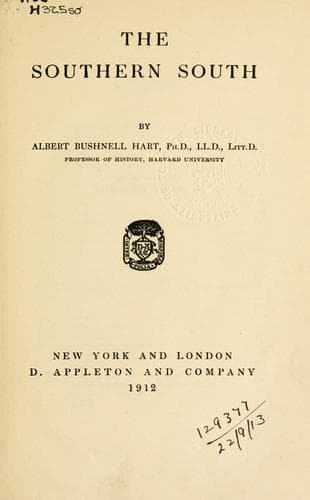
Southern States -- Social conditions; United States -- Race relations
typhoon will silt up those Texan lagoon harbors which have no great river
behind to scour them out.
Mobile, which is a place with increasing foreign commerce, can never hope
to lead deep water to its present wharves, but about twenty-two miles
below the city is an opportunity to bring large ships nearly inshore, and
that is likely to be the future port of Mobile. Pensacola is the special
favorite of the Louisville & Nashville Railroad, but seems to have no
advantages which will bring it ahead of its neighbor Mobile. Of the lower
Atlantic ports, Fernandina, Brunswick, Savannah, Charleston, and
Wilmington are all limited in the depth of water, and several of them
require difficult river navigation. The deep-water ports of Baltimore on
the Chesapeake, and Norfolk, Portsmouth, and Newport News on the lower
James, are on the extreme borders of the South and depend for their
prosperity chiefly on Western commerce.
The transportation business of the South, as in other parts of the Union,
has drifted into the hands of a comparatively few large corporations. The
Southern Railroad, the Atlantic Coast Line, the Seaboard Air Line, and the
Louisville & Nashville include nearly all the railroads between Virginia
and Mississippi. The Baltimore & Ohio, Chesapeake & Ohio, Norfolk &
Western, and the new Virginia Railroad connect the tide water of Virginia
and North Carolina with the West. The Louisville & Nashville, Illinois
Central, the Missouri Pacific and Queen and Crescent roads stretch
southward from the Middle Western states to the Gulf. In Texas three or
four railway systems compete for the business between the upper
trans-Mississippi country and the Gulf, and there is a bewildering complex
of branch lines. The net result is that the South outside the mountains is
gridironed with railways. The areas more than ten miles from a railroad
line in the South are now comparatively small. For this reason may be
expected a more rapid development of the resources and wealth of that
section in the next ten years than in the last decade.
CHAPTER XVII
COMPARATIVE WEALTH
Public-domain text, read in full here on John Shaqi.
Reviews
Reviews
No reviews yet
Be the first to share your thoughts on this work.
Elsewhere in the archive
Join the Discussion
Join the discussion
Sign in to leave a comment or review.
Sign InorCreate an account