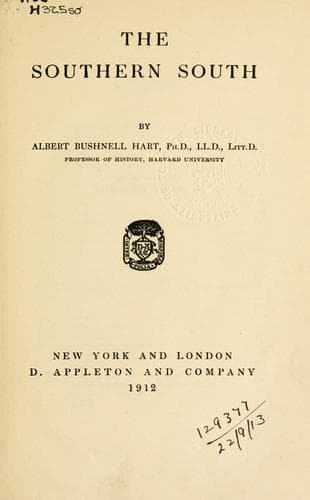
Southern States -- Social conditions; United States -- Race relations
The relative wealth of the two sections is best measured not by foreign
trade but by internal production and by public income and expenditure,
calculated on a per-capita basis. Of course conditions vary greatly from
state to state; in Alabama there is steady farm work most of the year,
while in North Dakota the winter is a time of comparative leisure;
California uses agricultural machinery, South Carolina depends chiefly on
hand tools; Wyoming is so young that it has had little time to accumulate
capital, Tennessee has large accumulations. It would be unfair to compare
Arkansas with Connecticut, or Illinois with Florida, on a strictly
per-capita basis. The only way to equalize conditions for a fair
comparison is to take groups of states and set them against other groups
of equivalent population and of similar interests, so that local errors
may neutralize each other.
As a basis for such a comparison of resources, three sets of tables have
been made up. The first sets apart the group of eleven seceding states
with 17,000,000 people (West Virginia not included) as being typically
Southern; and places against them a group of agricultural states extending
from Indiana to Oklahoma, also containing 17,000,000 people. The second
tables include the whole South--viz., the fifteen former slaveholding
states (excluding West Virginia), together with the District of Columbia,
including a population of about 28,000,000 people; to which is opposed the
Middle West and Pacific states from Indiana to the Coast, together with
Vermont and New Hampshire, which are added to make up a full 28,000,000.
To such comparisons the objection has been made that it averages the
confessedly inferior rural negro population with the picked immigrants
from the East and abroad in the Northwest. The objection is a concession
of the lower average productive capacity of the South; but in order to
compare the white elements of the two sections by themselves, a third set
of tables compares the whole South containing 17,900,000 whites and
8,000,000 blacks against a group of Northern agricultural states with a
population of 18,000,000 whites and 234,000 blacks.
Public-domain text, read in full here on John Shaqi.
Reviews
Reviews
No reviews yet
Be the first to share your thoughts on this work.
Elsewhere in the archive
Join the Discussion
Join the discussion
Sign in to leave a comment or review.
Sign InorCreate an account