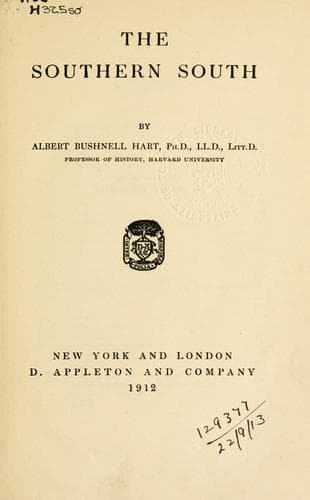
Southern States -- Social conditions; United States -- Race relations
The miles of railroad in the Southern group were 55,000; in the Western,
94,000; the total value of agricultural products in the South was
estimated at 1,060 millions, in the North at 1,945 millions. Even the
cotton crop of the eleven states, worth 550 millions, was overbalanced by
the Northern corn crop which brought 595 millions. The manufactures in the
South for 1905 were 1,267 millions; in the Northwest 2,932 millions. The
Southern group expended for schools 26 millions, the corresponding
Northern states expended 91 millions. The value of Southern school
property was 43 millions, of the Northern group it was 216 millions; the
average annual expenditure per pupil in daily attendance in the South was
$9.75; in the North about $28.45. For public benevolent institutions the
South expended in 1903 net $3,000,000, the North $7,000,000; the Southern
group had 1,070,000 illiterate Whites, of whom 76,000 were foreign born;
the Northern group had 207,000 besides 389,000 illiterate foreigners. In
the indices of accumulated property the comparison is about the same; the
Southern deposits in all banks were, in 1906, 701 million dollars, the
Northern 2,439 millions. In manufactures the Northern group, with a
capital of 2,240 million dollars and 903,000 hands, produced 2,932
millions; against Southern capital of 1,140 millions, employing 659,000
persons and producing 1,267 millions.
The comparison of valuations brings out one unexpected result, namely,
that several of the Southern states have actually less taxable property
now than they had fifty years ago. This does not mean that they are poorer
because they have lost their slaves. Leaving slaves out of account, in
1860 South Carolina had a valuation of $326,000,000; in 1906 of
$250,000,000; in Mississippi the valuation of real estate in 1860 was
$158,000,000; in 1906, with a population more than twice as great, it was
$131,000,000; in the rich state of Georgia the valuation in 1860,
deducting slaves, was $432,000,000 against $578,000,000 in 1906. The
Southern people feel justly proud of the fact that the valuations of the
eleven former members of the Confederacy between 1902 and 1906 increased
by 962 millions, from a total of 3,799 millions to 4,761 millions, that
their annual manufactures increased by 450 millions; from 819 millions in
1900 to 1,267 millions in 1905.
Public-domain text, read in full here on John Shaqi.
Reviews
Reviews
No reviews yet
Be the first to share your thoughts on this work.
Elsewhere in the archive
Join the Discussion
Join the discussion
Sign in to leave a comment or review.
Sign InorCreate an account