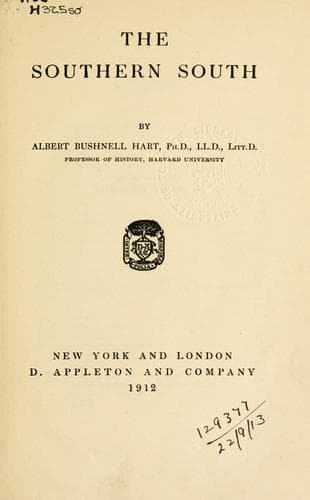
Southern States -- Social conditions; United States -- Race relations
How far has this rate of progress been continued since 1880 as shown by
the inexorable method of comparing groups of Southern states with groups
of Northwestern states of equal population? The tax valuation shows about
the same proportion, so far as can be ascertained, to real values in one
section as in the other. The local differences of mode of assessment when
averaged would probably not disturb the result by more then ten per cent.
The whole South (16 communities) as compared with a Northern group of the
same number of people in 1907 showed 8.5 billions of assessed property
against 13.7 billions in the North. It may therefore be set down as proven
that the taxable wealth of the lower agricultural South is less than half
that of similar agricultural communities in the North; so that while
mining and manufacturing states like Maryland, Kentucky, and Missouri have
about the same wealth as similar Northern communities, the South as a
whole has not one half the wealth. Take the former slaveholding states all
together, including such a rich commonwealth as Missouri, and the farm
value in the whole region in 1900, with 28 millions of people, was under
5,000 millions; while 28 million people in the West and Northwest owned
farms to the amount of about 11,000 millions, or more than double. The
total Southern crops in 1899, the last year in which the totals are
obtainable, were worth 1,360 millions, the Northern crops counted up to
2,390 millions. The value of the Southern corn crop in 1905 was 416
million dollars; the equivalent population in the Northwest raised 601
million dollars' worth of corn. The whole South raises about 32 million
dollars' worth of oats; the North raises 201 millions. The Southern potato
crop is worth 19 millions; the Northern, 76 millions. Southern hay counts
up to 66 millions and Northern to 258 millions. Even in tobacco, the North
furnishes 7 million dollars' worth against 35 million dollars in the
South. Cotton is the one crop that is exclusively Southern, and the crop
of 1905, the year that we are considering, including the seed, was worth
632 million dollars. The Southern group had 127,000 teachers, school
property of 84 millions, and total school revenue of 45 millions, against
competing Northern figures of 199,000, of 293 millions, and of 120
millions. It is difficult in these figures to find justification for the
notion that the South as an agricultural region is richer than the North,
or is likely ever to rival it.
Public-domain text, read in full here on John Shaqi.
Reviews
Reviews
No reviews yet
Be the first to share your thoughts on this work.
Elsewhere in the archive
Join the Discussion
Join the discussion
Sign in to leave a comment or review.
Sign InorCreate an account