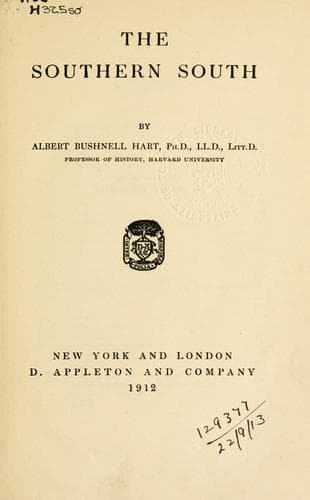
Southern States -- Social conditions; United States -- Race relations
With their families--for the unit on the plantation is not a hand, but a
family, or where three or four unmarried men or unmarried women work
together, a gang. This practice, combined with the child labor in cotton
mills, accounts for the large number of persons under fifteen years
old--more than half the boys in some states--who are employed in gainful
occupations. This is one of the most striking divergences from any kind of
Northern farming where plenty of farmers' wives ride the mowing machine,
and farmers' sisters pick fruit, and farmers' children drop potatoes,
where foreign women often work in garden patches, but where people do not
habitually employ women and children at heavy field labor.
The best Negroes, unless they own land of their own, seek the form of
contract most advantageous to themselves, paying either a money rent of
two dollars to eight dollars an acre, or an equivalent cotton rent. It is
generally believed that the renters are the people most likely to save
money and buy property for themselves. In Dunleith, Mississippi, a crew of
seven people came in with a hundred dollars' worth of property, and three
years later went away with more than a thousand dollars' worth of
accumulated stock, tools and personal property. A renter must have animals
of his own, and is obliged to feed them and to keep up his tools. Some
planters find that renters leave them just as they are doing well, and
that the land is skinned by them. In general, however, a Negro who has the
necessary mules can always find a chance to rent land.
The share hand or cropper is next in point of thrift; the planter
furnishes him house, wood, seed, animals, and implements; and at the end
of the year the value of the crop is divided between owner and tenant,
either half and half or "three fifths and four fifths," which means that
the Negro gets three fifths of the cotton and four fifths of the corn.
A third class is the wage hands, who in general have not the ability to
rent land on any terms; they receive a house and fuel, and wages, from
fifteen dollars a month up to a dollar a day. Where steady wage hands can
be found, this is considered the best arrangement for the planter.
Renters and croppers may be supplemented by extra work, paid for by them,
or charged to them. If they get into a tight place with their cotton, the
manager sends wage hands to their aid, and at picking time all available
help of all ages is scraped together and sent out according to the needs
of the plantation. Of course, a renter or a "cropper" may allow members of
his family to work for others, if he cannot keep them busy. On some
plantations tenants pay on an average nearly a hundred dollars a year for
this extra help.
Public-domain text, read in full here on John Shaqi.
Reviews
Reviews
No reviews yet
Be the first to share your thoughts on this work.
Elsewhere in the archive
Join the Discussion
Join the discussion
Sign in to leave a comment or review.
Sign InorCreate an account