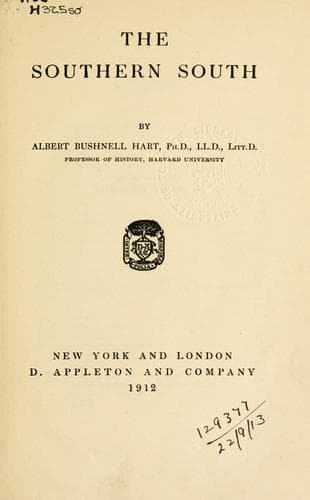
Southern States -- Social conditions; United States -- Race relations
From the earlier chapters on the Negroes and on the Cotton Hands it is
plain that the Southern agricultural laborer is unsatisfactory to his
employer, and not happy in himself; that the two races, though allied, are
yet in disharmony. Of recent years a new or rather a renewed cause of race
hostility has been found, because the great demand for labor, chiefly in
the cotton fields, gives rise to the startling abuse of a system of forced
labor, commonly called peonage, which at the mildest is the practice of
thrashing a hand who misbehaves on the plantation, and in its farthest
extent is virtually slavery. For this system the white race is solely
accountable, inasmuch as it is the work of white men, sometimes under the
protection of laws made by white legislatures, and always because of an
insufficient public sentiment among white people.
When the slaves were set free, the federal government was careful to
protect them against a relapse into bondage. The Thirteenth Amendment,
which went into effect in 1865, absolutely prohibited "slavery or
involuntary servitude except as a punishment for crime whereof the party
shall have been duly convicted." In addition, in 1867, an act of Congress
formally prohibited "the system known as peonage." A further statue of
1874 declared it a crime "to kidnap or carry away any other person with
intent to hold him in involuntary servitude." The word "peonage" comes
from the Mexican system of serfdom, the principle of which is, that if an
employee owes his master he must continue to serve him until that debt is
paid, the only escape being that if another employer is willing to come
forward and assume the debt the employee is allowed to transfer his
obligation to the new master. In practice, the system amounts to
vassalage, inasmuch as the debt is usually allowed to reach a figure which
there is no hope of paying off.
The term "involuntary servitude" is clear enough, and it is a curious fact
that when the Philippine Islands were annexed there was a system of
slavery in the Sulu Archipelago which was actually recognized by a treaty
made by General Bates; but the federal government dropped the treaty, and
there is no doubt that the United States courts would uphold any Sulu
bondman who sought his liberty under the Thirteenth Amendment.
In 1865 some of the Southern states passed vagrant laws under which
Negroes were obliged to make a labor contract for a year, and could be
compelled to carry out that contract; and the belief in the North that
these statutes were virtually intended to reënslave the freedmen was one
of the mainsprings of the Fourteenth Amendment and the other
Reconstruction legislation.
Public-domain text, read in full here on John Shaqi.
Reviews
Reviews
No reviews yet
Be the first to share your thoughts on this work.
Elsewhere in the archive
Join the Discussion
Join the discussion
Sign in to leave a comment or review.
Sign InorCreate an account